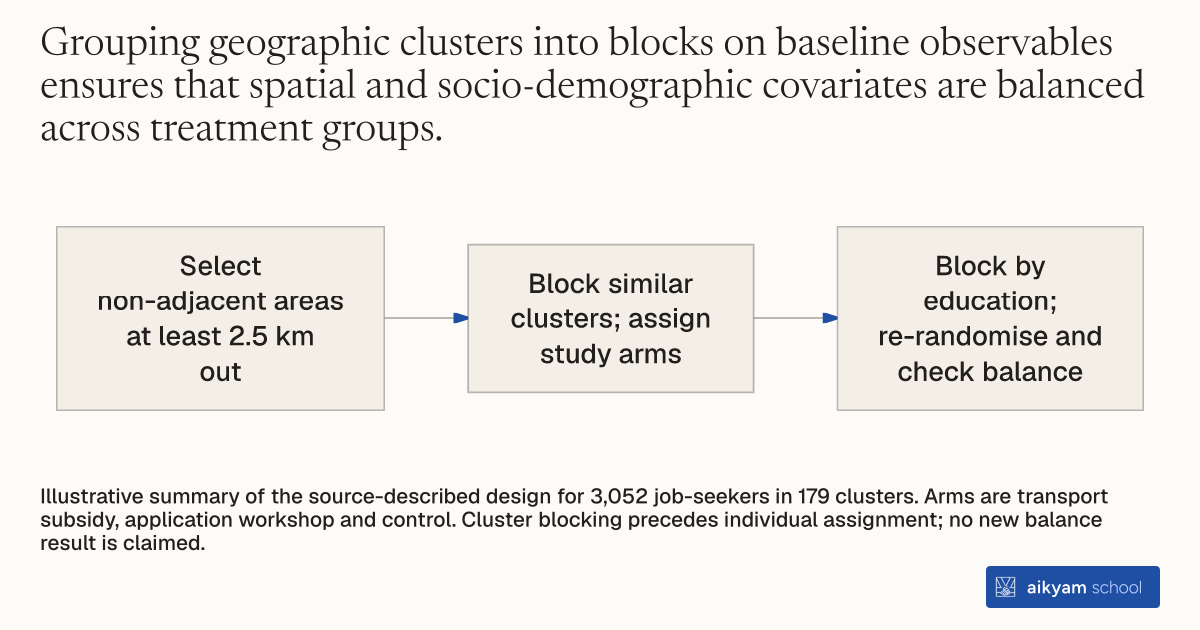
Research steps
Block areas before assigning study arms
- Select non-adjacent areas at least 2.5 km out
- Block similar clusters; assign study arms
- Block by education; re-randomise and check balance
Illustrative summary of the source-described design for 3,052 job-seekers in 179 clusters. Arms are transport subsidy, application workshop and control. Cluster blocking precedes individual assignment; no new balance result is claimed.
See source →How
When to use
Researchers need to evaluate labor market interventions across spatial areas without incurring balance failures. Unstratified individual randomization risks baseline imbalances across spatial clusters and ignores local demographic variations. Group non-adjacent geographic clusters into balanced treatment blocks using observable baseline variables and re-randomization algorithms.
Assign geographic clusters to experimental arms using spatial block randomization and individual re-randomization.
- Select non-adjacent geographic enumeration areas located at least 2.5 km away from the city center.
- Group clusters into blocks based on baseline distance to city center, sample size, education levels, and baseline search activity.
- Randomly assign geographic clusters within each block to transport subsidy, application workshop, or control groups.
- Block individual participants within each cluster by education tier to ensure balanced representation.
- Implement a re-randomization algorithm to assign treatment status while verifying balance across baseline covariates.
Why it works
Re-randomization prevents accidental baseline imbalances across education levels and spatial areas.
Example
Researchers assigned 179 geographic clusters containing 3,052 young job-seekers across Addis Ababa, Ethiopia. Clusters were blocked on distance to city center, cluster sample size, education levels, ethnicity, and search activity.
About the study
Participants
N = 3,052 young job-seekers across 179 geographic clusters in Addis Ababa, Ethiopia.
Study Design
Cluster-level block randomization combined with individual re-randomization based on baseline education tiers.
Results
Achieved full baseline balance across all pre-specified covariates, with joint F-tests confirming no statistically significant baseline differences between treatment and control groups across all outcomes.