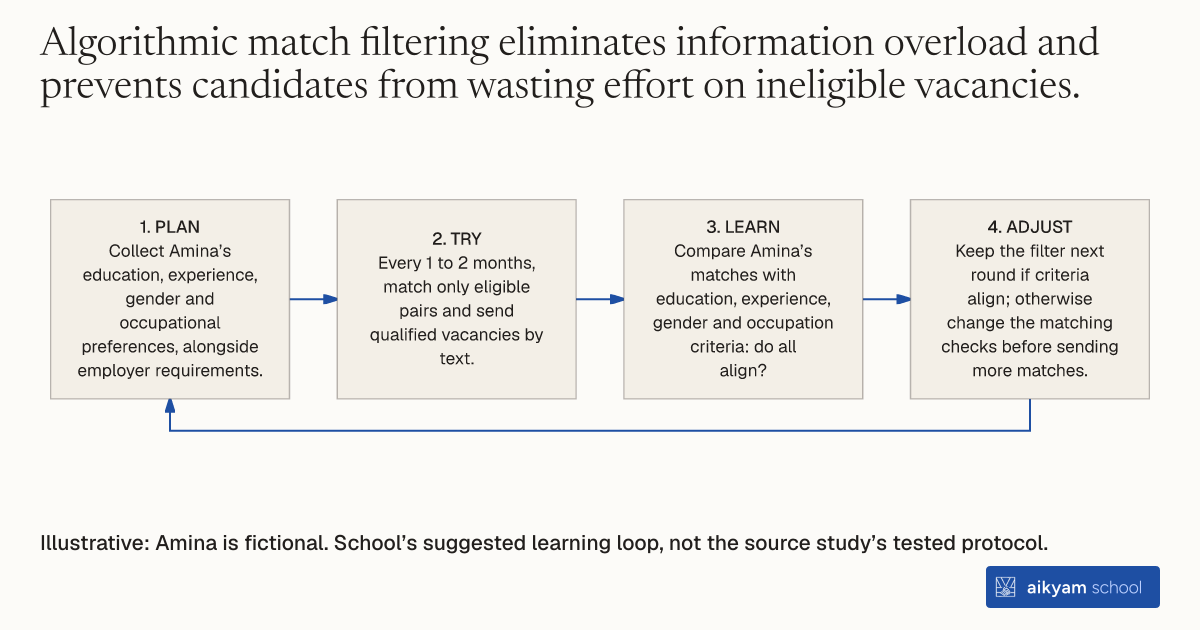
Try, learn and adjust
Check matches meet candidate and vacancy criteria
- Plan: Collect Amina’s education, experience, gender and occupational preferences, alongside employer requirements.
- Try: Every 1 to 2 months, match only eligible pairs and send qualified vacancies by text.
- Learn: Compare Amina’s matches with education, experience, gender and occupation criteria: do all align?
- Adjust: Keep the filter next round if criteria align; otherwise change the matching checks before sending more matches.
Illustrative: Amina is fictional. School’s suggested learning loop, not the source study’s tested protocol.
See source →School’s suggested, untested learning loop. Observe match eligibility and reported preferences; no application or interview gain is assumed.
How
When to use
In job search platforms, jobseekers face friction when evaluating unvetted job ads without knowing if they qualify. Automated match filtering pairs candidates only with open positions that meet their reported qualification levels and occupational preferences. It is intended for public and private employment agencies operating telephone or digital job-matching platforms.
Filter and generate bilateral candidate-vacancy matches by applying rule-based criteria linking registered candidate profiles with employer vacancy requirements.
- Collect candidate baseline profiles covering completed education, years of work experience, gender, and occupational preferences during intake.
- Record employer vacancy requirements covering minimum required education, minimum work experience, gender preferences, and occupational category.
- Program a rule-based algorithm to evaluate candidate profiles against new employer vacancy listings every 1 to 2 months.
- Restrict match generation strictly to pairs where the candidate meets or exceeds required education, meets required experience, aligns with gender preference, and selected the occupation.
- Transmit the resulting batch of qualified job matches to candidates via standardized text messages.
Why it works
This establishes a well-defined search set where every presented vacancy aligns with candidate qualifications and reported interests.
Example
On the Job Talash platform in Lahore, Pakistan, an automated matching algorithm processed 9,838 registered jobseekers against 1,343 employer vacancies over four years, generating 1,116,952 qualified jobseeker-vacancy matches (an average of 113 matches per candidate).
About the study
Participants
N = 9,838 jobseekers (1,116,952 jobseeker-vacancy matches) across 1,343 vacancies in Lahore, Pakistan; candidates averaged 7.9 years work experience, ranging from primary to university education.
Study Design
Observational match-level platform tracking within a randomized controlled trial analyzing application and interview outcomes across 1,116,952 generated matches.
Results
The algorithm generated an average of 113 matches per jobseeker (1.8 per month), where control candidates applied to 0.185% of matches and achieved a 6.29% interview invitation probability per submitted application.