Research design
Compare crop decisions by baseline literacy
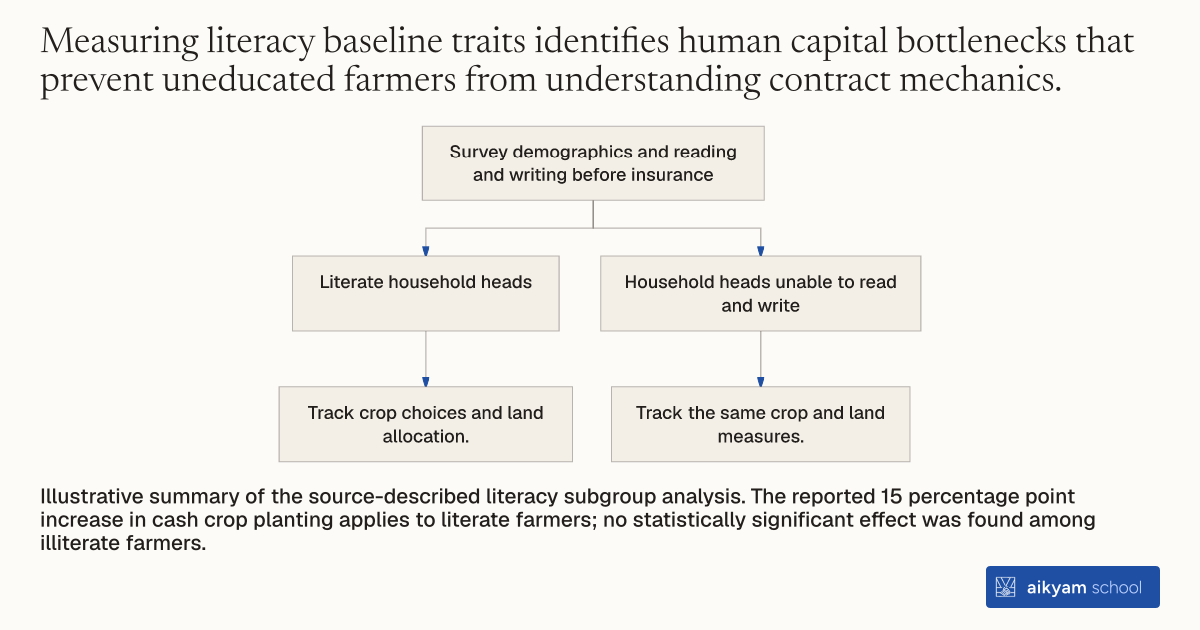
Survey demographics and reading and writing before insurance
- Literate household heads
- Track crop choices and land allocation.
- Household heads unable to read and write
- Track the same crop and land measures.
Illustrative summary of the source-described literacy subgroup analysis. The reported 15 percentage point increase in cash crop planting applies to literate farmers; no statistically significant effect was found among illiterate farmers.
See source →How
When to use
Innovative financial products like rainfall insurance require baseline literacy skills to understand contract terms. Uneducated target groups often fail to respond to financial risk coverage. Profile smallholder farming stakeholders and stratify intervention analysis by literacy to identify target groups capable of utilizing financial products.
Collect household demographic and literacy data from target smallholders to stratify financial program uptake and impact evaluation.
- Survey household heads across target rural farming communities before introducing financial insurance products.
- Record primary demographic indicators including household size, head age, gender, and formal schooling attendance.
- Test and classify household heads by their ability to read and write.
- Segment the target farming population into literate and illiterate household categories.
- Track crop choice decisions and land allocation separately across literacy subgroups following financial interventions.
- Target financial literacy training to low-literacy segments before rolling out microinsurance contracts.
Why it works
Stratifying uptake by literacy ensures financial intervention designs address educational barriers to product adoption.
Example
Researchers collected baseline demographics for 1,479 farming households in Andhra Pradesh, India, finding that 54 percent of household heads never attended school and less than half were literate. Evaluating rainfall insurance effects across literacy strata revealed that literate farmers increased cash crop adoption by 15 percentage points, whereas illiterate farmers exhibited zero change in cash crop production.
About the study
Participants
1,479 small farming households across 45 villages in Andhra Pradesh, India; average household size 5.35 members, household head average age 49.6 years (91% male, 54% with no formal schooling, under 50% literate).
Study Design
Randomized Controlled Trial (RCT) subgroup heterogeneity analysis stratifying insurance impact by literacy status and years of formal education.
Results
Literate farmers receiving rainfall insurance were 15 percentage points more likely to plant cash crops, whereas insurance provision had no statistically significant effect on cash crop production among illiterate farmers.