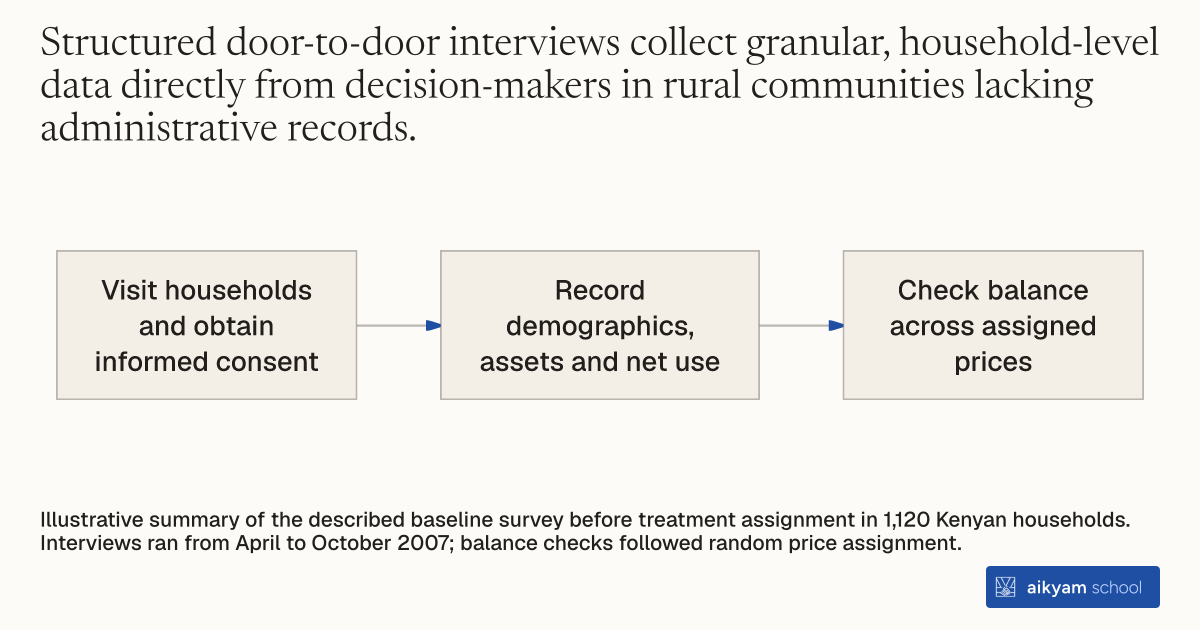
Research steps
Record household conditions before treatment
- Visit households and obtain informed consent
- Record demographics, assets and net use
- Check balance across assigned prices
Illustrative summary of the described baseline survey before treatment assignment in 1,120 Kenyan households. Interviews ran from April to October 2007; balance checks followed random price assignment.
See source →How
When to use
Researchers need to evaluate community health needs, existing preventive asset ownership, and economic status before launching an intervention. Administering door-to-door survey questionnaires collects precise socio-economic and demographic baseline data across sampled families. This diagnostic information enables researchers to verify sample balance across treatment arms and accurately isolate the effects of subsequent interventions.
Administer structured baseline questionnaires at target households to record demographics, asset wealth, and health behaviors prior to intervention deployment.
- Deploy trained enumerators to visit sampled households in their homes prior to assigning experimental treatments.
- Obtain informed consent from the female, male, or joint household heads before starting the interview.
- Record demographic information including household size, head of household age, and number of residing children under 18 years old.
- Assess socioeconomic indicators by recording primary education completion, income-generating members, bank account status, electricity access, and total household asset index value.
- Log baseline health ownership and preventive behaviors including total bed nets owned, net types, recent usage rates, and declared willingness to pay for new health goods.
Why it works
Standardized baseline surveys ensure orthogonality between randomized treatment arms and observable background characteristics.
Example
In rural Western Kenya, field enumerators visited 1,120 sampled households between April and October 2007 to administer structured baseline surveys assessing family size, asset indices, and net ownership prior to distributing subsidy vouchers.
About the study
Participants
1,120 rural households across six enumeration areas in Busia District, Kenya, with average household size 7.1 and 5.4 children under 18.
Study Design
Door-to-door surveys administered to female and/or male household heads, followed by regression checks to confirm orthogonality with randomized prices.
Results
At baseline, 80 percent of households owned at least one bed net, but only 41 percent of individual household members regularly slept under a net.