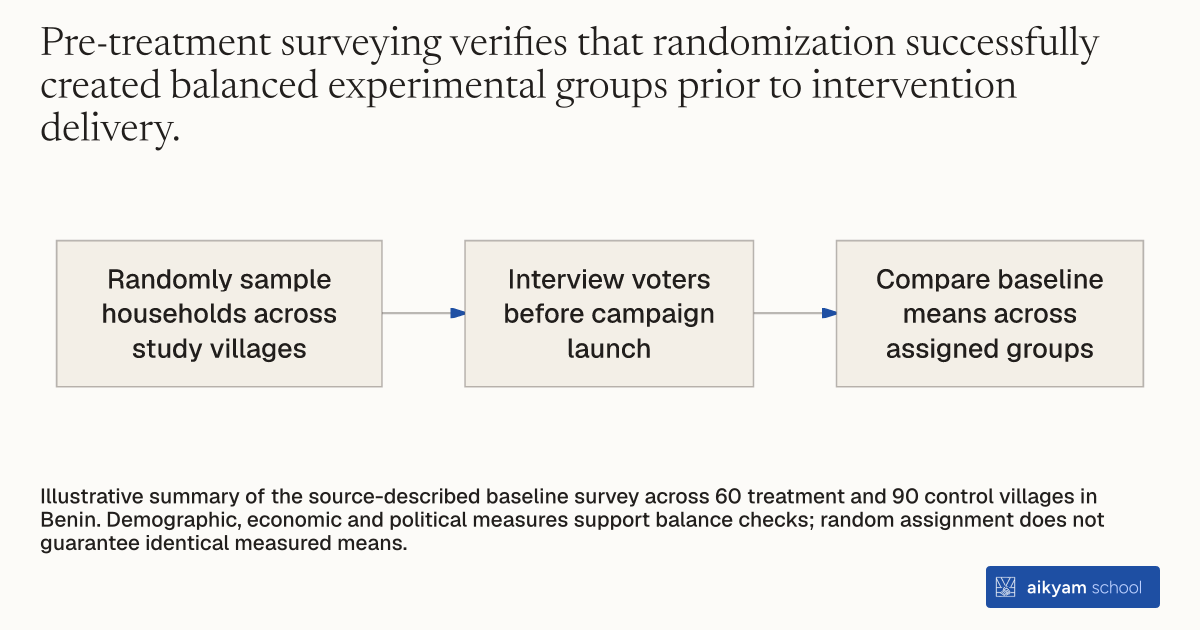
Research procedure
Measure baseline before campaigning
- Randomly sample households across study villages
- Interview voters before campaign launch
- Compare baseline means across assigned groups
Illustrative summary of the source-described baseline survey across 60 treatment and 90 control villages in Benin. Demographic, economic and political measures support balance checks; random assignment does not guarantee identical measured means.
See source →How
When to use
Evaluating political campaigns or electoral field experiments requires establishing demographic and attitudinal baselines prior to intervention. Conduct pre-treatment voter surveying to verify sample balance across experimental conditions and document baseline political knowledge, assets, and preferences. This allows researchers and planners to identify potential confounders before campaign treatments begin.
Administer a structured pre-treatment survey to a representative sample of registered voters across treatment and control units before initiating campaign activities.
- Draw a representative random sample of households within every selected study unit.
- Deploy trained enumerators to interview prospective voters in selected households prior to campaign launch.
- Collect demographic data including respondent age, gender, spoken languages, and education level.
- Measure socioeconomic status by recording steady income source and household landholding size.
- Gauge political knowledge and preferences, including familiarity with local mayors, presidential candidates, and expected turnout.
- Compare mean baseline values between treatment and control groups to verify statistical balance across covariates.
Why it works
It allows researchers to identify initial imbalances and control explicitly for baseline differences in subsequent empirical estimation.
Example
Prior to the March 2011 presidential election in Benin, research staff surveyed 5,009 representative household respondents across 150 villages in 30 electoral districts, collecting data on demographic, political, and economic variables to verify balance before campaign town halls and rallies began.
About the study
Participants
5,009 representative household respondents across 150 villages in 30 communes across Benin.
Study Design
Pre-treatment baseline survey administered across randomly assigned treatment (60 villages) and control (90 villages) units, evaluated using two-sided t-tests of mean equality across demographic, political, and economic covariates.
Results
Balance tests showed baseline female proportion of 0.61 in treatment vs 0.59 in control (p = 0.08), mean age of 36.97 vs 37.08 (p = 0.40), steady income index of 1.78 vs 1.77 (p = 0.64), education of 0.49 vs 0.46 (p = 0.04), and expected turnout of 1.05 vs 1.08 (p = 0.05).