Research steps
Sample households from school registers
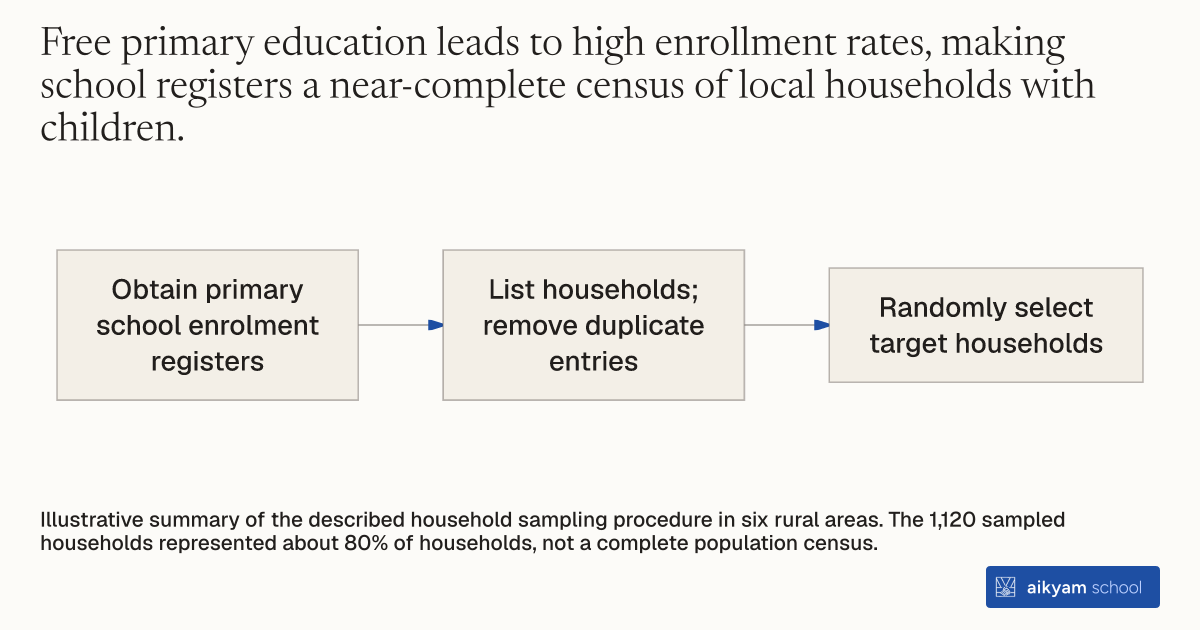
- Obtain primary school enrolment registers
- List households; remove duplicate entries
- Randomly select target households
Illustrative summary of the described household sampling procedure in six rural areas. The 1,120 sampled households represented about 80% of households, not a complete population census.
See source →How
When to use
Researchers need a representative sampling frame of local households with children in rural communities where formal population censuses do not exist. Utilizing primary school enrollment records provides an accessible census proxy because most households in target areas have school-aged children. This approach allows field teams to identify, locate, and recruit local families efficiently for community health interventions.
Construct a household sampling frame using primary school enrollment records in rural communities.
- Obtain official student attendance and enrollment registers from primary schools within each target village.
- Compile a list of all households that have children enrolled in those primary schools.
- Cross-check and remove duplicate household entries for families with multiple enrolled children.
- Apply computer-generated random numbers to select target households from the compiled list.
Why it works
School registers provide a low-cost, accurate list of local households without requiring expensive door-to-door censuses.
Example
In Busia District, Western Kenya, researchers used primary school registers across six rural areas to sample 1,120 households, representing approximately 80 percent of all households in the study areas.
About the study
Participants
1,120 households across six rural enumeration areas in Busia District, Western Kenya, where 68 percent of individuals lived below the poverty line.
Study Design
School registers were used to construct the household sampling frame, followed by computer-generated random assignment of target subsidy levels across households.
Results
Sampling through primary school registers captured an estimated 80 percent of all households in the study areas, leveraging an 86 percent net primary enrollment rate.