Try, learn and adjust
Check cash transfer conditions and support
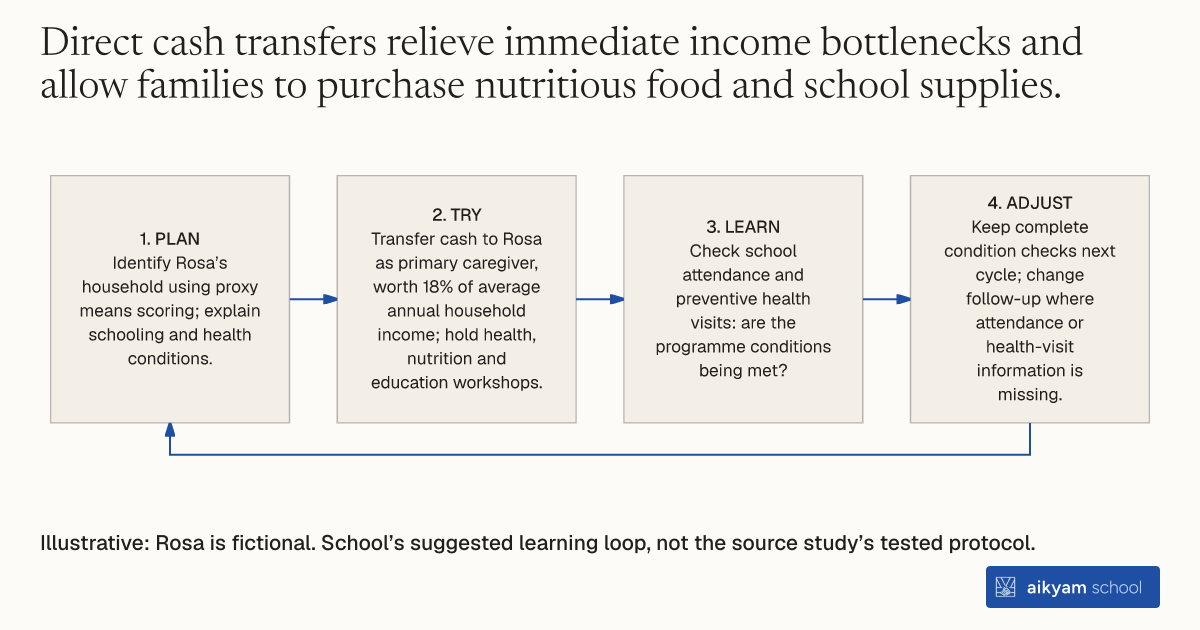
- Plan: Identify Rosa’s household using proxy means scoring; explain schooling and health conditions.
- Try: Transfer cash to Rosa as primary caregiver, worth 18% of average annual household income; hold health, nutrition and education workshops.
- Learn: Check school attendance and preventive health visits: are the programme conditions being met?
- Adjust: Keep complete condition checks next cycle; change follow-up where attendance or health-visit information is missing.
Illustrative: Rosa is fictional. School’s suggested learning loop, not the source study’s tested protocol.
See source →School’s suggested, untested learning loop. Observe school attendance, health visits and cash delivery; this illustrative loop is not evidence of lasting effects.
How
When to use
Poor rural households face financial constraints that reduce investments in children's education and nutrition. Low investment reinforces intergenerational poverty across rural communities. Apply this method for low-income mothers with children of primary school age.
Deliver conditional cash transfers alongside social marketing messages to primary female caregivers in poor rural communities.
- Identify poor eligible households in targeted municipalities using a proxy means test.
- Transfer cash directly to the primary female caregiver amounting to eighteen percent of average annual household income.
- Require parents to keep children enrolled in primary school with regular attendance.
- Mandate regular health center visits and preventive health checkups for young children.
- Hold community workshops on health, diversified nutrition, and educational values to reinforce program objectives.
Why it works
Conditionalities and explicit social marketing shift parental habits toward sustained human capital investments.
Example
In 2006, the Ministry of the Family in Nicaragua delivered the basic cash transfer package to eligible households in northwestern municipalities, reaching a ninety-five percent take-up rate among selected families.
About the study
Participants
3,000 eligible poor households across 56 treatment and 50 control communities in 6 municipalities of northwestern Nicaragua.
Study Design
Two-stage randomized controlled trial assigning communities to treatment or control, followed by individual randomized allocation of transfer packages among eligible households.
Results
Program take-up reached 95 percent, and the basic transfer represented 18 percent of average annual household income, increasing short-term human capital investments.