Try, learn and adjust
Check joint purchases meet household needs
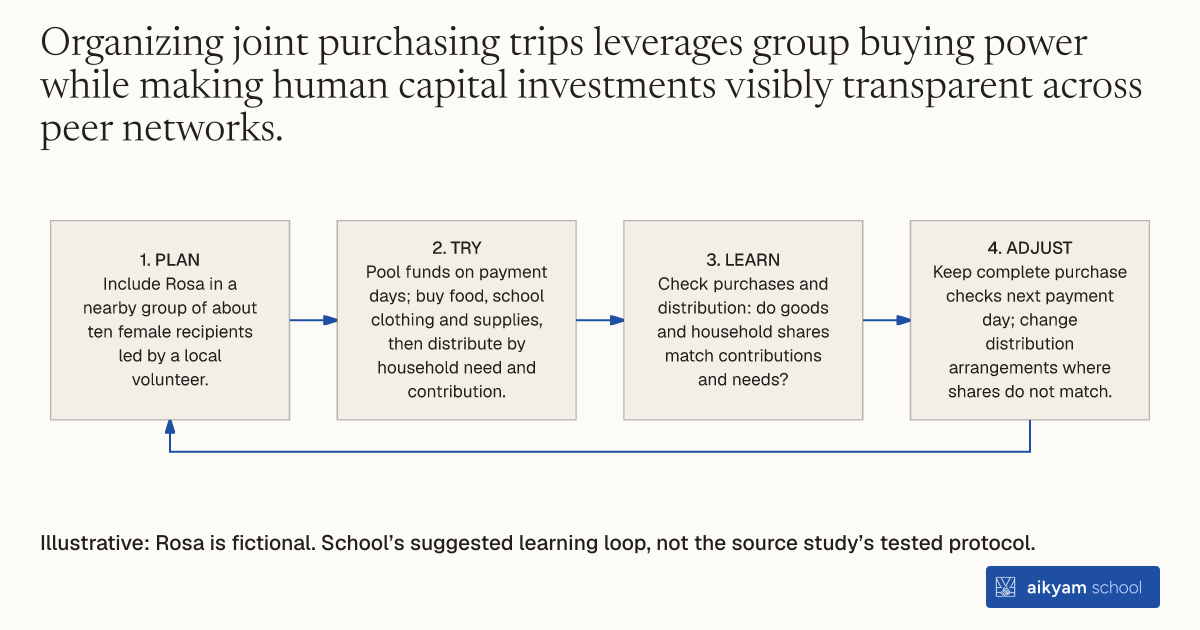
- Plan: Include Rosa in a nearby group of about ten female recipients led by a local volunteer.
- Try: Pool funds on payment days; buy food, school clothing and supplies, then distribute by household need and contribution.
- Learn: Check purchases and distribution: do goods and household shares match contributions and needs?
- Adjust: Keep complete purchase checks next payment day; change distribution arrangements where shares do not match.
Illustrative: Rosa is fictional. School’s suggested learning loop, not the source study’s tested protocol.
See source →School’s suggested, untested learning loop. Observe pooled contributions, goods purchased and household shares; group purchases alone are not the evaluated package.
How
When to use
Poor rural caregivers receiving cash transfers often face high transaction costs when purchasing nutritious food and school supplies individually. Individual spending can be diverted to non-essential goods or short-term consumption without social accountability. Apply this method during payment days for beneficiary women organized into local peer groups.
Organize cash transfer beneficiaries into peer groups to pool funds and make joint purchases of child human capital supplies on transfer payment days.
- Form small peer groups of approximately ten neighboring female cash transfer recipients coordinated by a local female promotora.
- Schedule collective purchasing trips timed directly with cash transfer distribution payment days.
- Pool individual cash transfer funds within each peer group to buy essential food products, school clothing, and educational supplies in bulk.
- Allow group members to directly observe each recipient's purchases, ensuring funds go toward child nutrition and education.
- Distribute the purchased goods among peer group members according to household needs and contributed transfer amounts.
Why it works
Direct peer observation reinforces social norms around spending cash transfers on child health, food, and schooling.
Example
During cash transfer payment days in 2006, volunteer promotoras across 56 treatment communities in northwestern Nicaragua organized their peer groups of 10 beneficiaries to collectively buy nutritious food and school materials for their children.
About the study
Participants
3,000 eligible poor households across 56 treatment communities in 6 municipalities of northwestern Nicaragua.
Study Design
Two-stage randomized controlled trial assigning communities to treatment or control, followed by individual randomized allocation of transfer packages among eligible households organized into promotora groups.
Results
Exposure to leaders organizing peer interactions reduced school absences by 0.4 days per month and increased school expenditures by 16 percent two years after transfers ended.