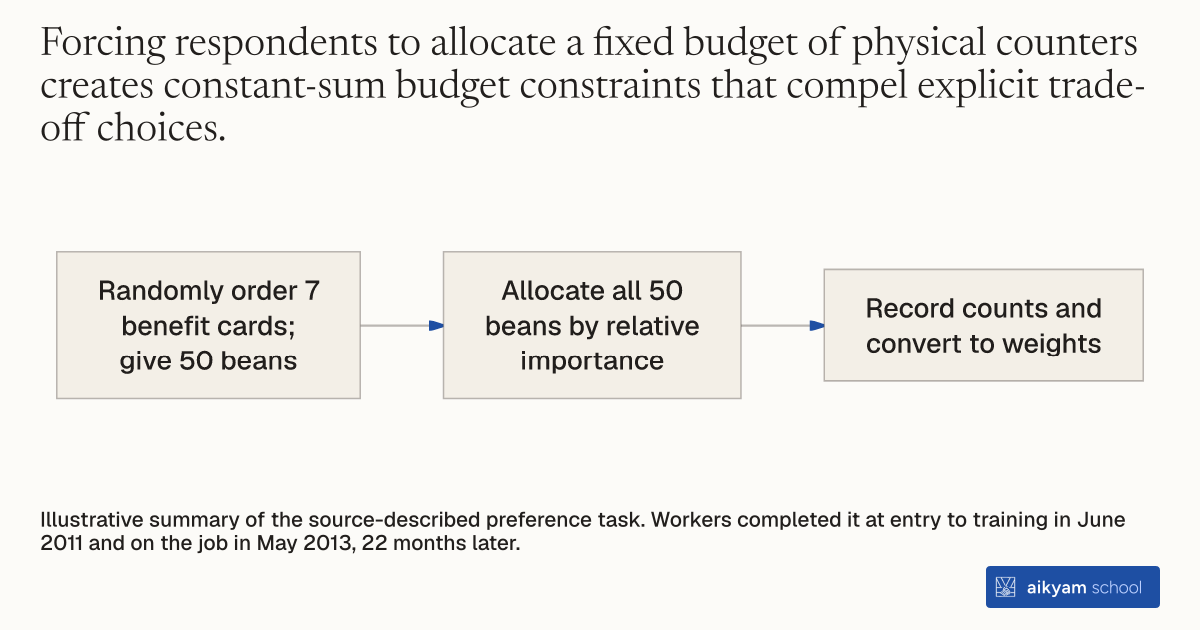
Research steps
Allocate 50 beans across job benefits
- Randomly order 7 benefit cards; give 50 beans
- Allocate all 50 beans by relative importance
- Record counts and convert to weights
Illustrative summary of the source-described preference task. Workers completed it at entry to training in June 2011 and on the job in May 2013, 22 months later.
See source →How
When to use
Organizations need to measure employee job motivations and perceived benefits without relying on unconstrained survey ratings. Standard rating scales allow respondents to rate all benefits as highly important without facing trade-offs. Asking workers to distribute a fixed count of physical counters across job benefit cards forces explicit trade-off decisions among competing incentives.
Elicit relative job motivation and perceived benefits by requiring workers to allocate a fixed number of physical counters across benefit cards.
- Enumerators place cards describing distinct job benefits in random order on a flat table before the respondent.
- Surveyors provide each worker with a bag containing exactly 50 beans representing total preference weight.
- Instruct the respondent to distribute the 50 beans across the benefit cards in proportion to each benefit's relative importance.
- Surveyors verify that the worker allocates all 50 beans across cards, forcing explicit trade-off choices between job features.
- Record the bean count allocated to each card and convert counts into proportional weights for analytical comparison across worker cohorts.
Why it works
This prevents uniform high-rating inflation while allowing researchers to evaluate whether promotional framings alter specific perceived job benefits relative to others.
Example
In Zambia, researchers administered the 50-bean allocation exercise to 314 recruited Community Health Assistants upon arrival at residential training in Ndola and again 22 months later on the job. At entry, health workers recruited through career-focused advertisements allocated 38 percent more beans to "good future career" (0.164 weight vs 0.119, p=0.002) and fewer beans to "allows me to serve the community" (0.397 vs 0.436, p=0.046). On the job 22 months later, control recruits' bean allocation to career advancement increased by 27 percent to 0.151, eliminating baseline perception differences across recruitment groups.
About the study
Participants
314 recruited Community Health Assistants (307 graduating health workers, average age 26, 30 percent female) across 48 rural districts in Zambia.
Study Design
Longitudinal constant-sum survey methodology administering a 50-bean allocation task across 7 job benefit cards at entry to training (June 2011) and after deployment (May 2013).
Results
Career treatment recruits placed 38 percent more weight on career opportunities at entry relative to control (0.164 vs 0.119, p=0.002) and less weight on community service (0.397 vs 0.436, p=0.046) and community respect (0.037 vs 0.059, p=0.031). After 22 months, perceived career weights converged with no statistically significant differences across groups (0.160 vs 0.151, p=0.650).