Research procedure
Compare short recall with monthly recall
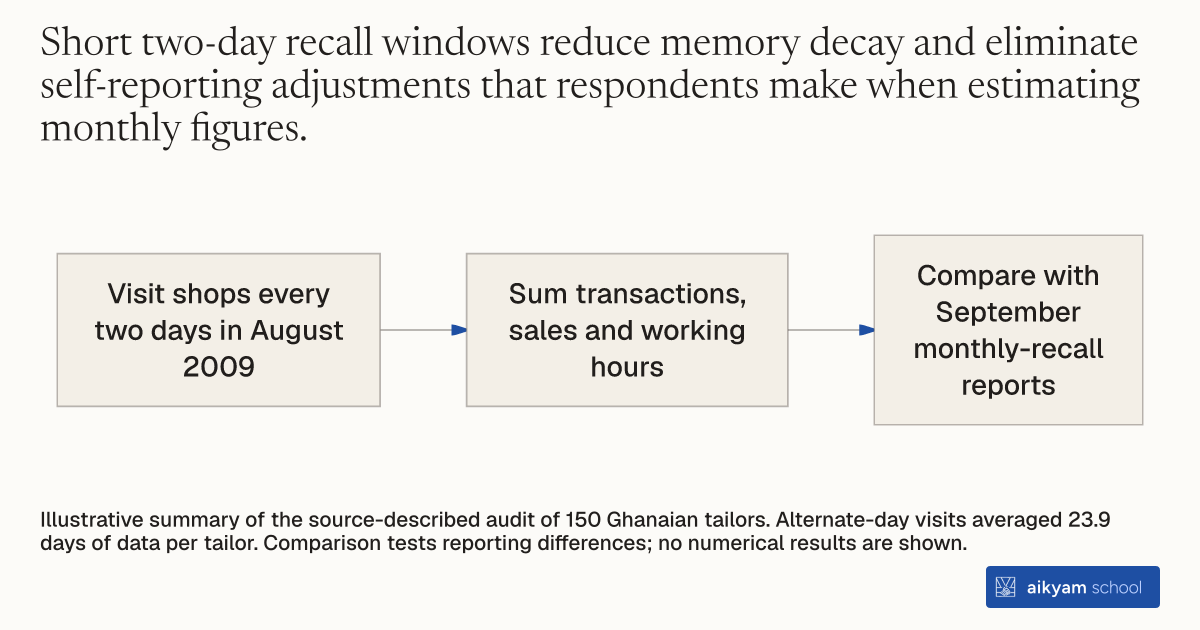
- Visit shops every two days in August 2009
- Sum transactions, sales and working hours
- Compare with September monthly-recall reports
Illustrative summary of the source-described audit of 150 Ghanaian tailors. Alternate-day visits averaged 23.9 days of data per tailor. Comparison tests reporting differences; no numerical results are shown.
See source →How
When to use
Evaluating microenterprise management training often relies on monthly recall surveys that risk recall bias or strategic misreporting. Conducting frequent in-person shop audits every two days collects precise daily operational transactions and verifies the reliability of standard monthly recall data. This method serves research teams seeking to measure small-business revenue without recall distortion.
Conduct alternate-day in-person shop visits to record microenterprise financial transactions and operational activity.
- Assign trained enumerators to visit each microenterprise shop every two days over a one-month audit period.
- Log total daily cash received from clients, total cash spent on supplies, and net cash earnings for the prior two days.
- Record the exact number of garment sales made and total hours worked by the shop owner during the two-day window.
- Categorize the specific clothing items produced and sold during each two-day reporting period.
- Aggregate alternate-day audit logs at the end of the month to calculate accurate monthly totals.
- Compare aggregated daily visit totals against standard end-of-month recall survey responses to test for reporting bias.
Example
Surveyors visited 150 tailors in Accra, Ghana, every other day during August 2009, gathering an average of 23.9 days of data per tailor. The high-frequency data averaged 8.11 cedis in daily cash received and 3.32 cedis in daily cash spent, matching monthly recall figures closely and proving monthly recall surveys did not suffer from systematic consulting treatment bias.
About the study
Participants
150 urban microenterprise tailors and seamstresses in Accra, Ghana.
Study Design
Methodological verification tracking tailors every other day across August 2009 (Round 4, averaging 23.9 days of data per tailor) compared against monthly recall surveys in September 2009 (Round 5).
Results
Alternate-day surveying yielded mean daily cash in of 8.11 cedis, cash out of 3.32 cedis, and net cash of 4.12 cedis across 3,583 daily observations. Differences between summed daily data and monthly recall were statistically insignificant for revenue (-4.08 cedis, p > 0.10) and expenses (8.71 cedis, p > 0.10), confirming that monthly recall data are on average accurate and unbiased.