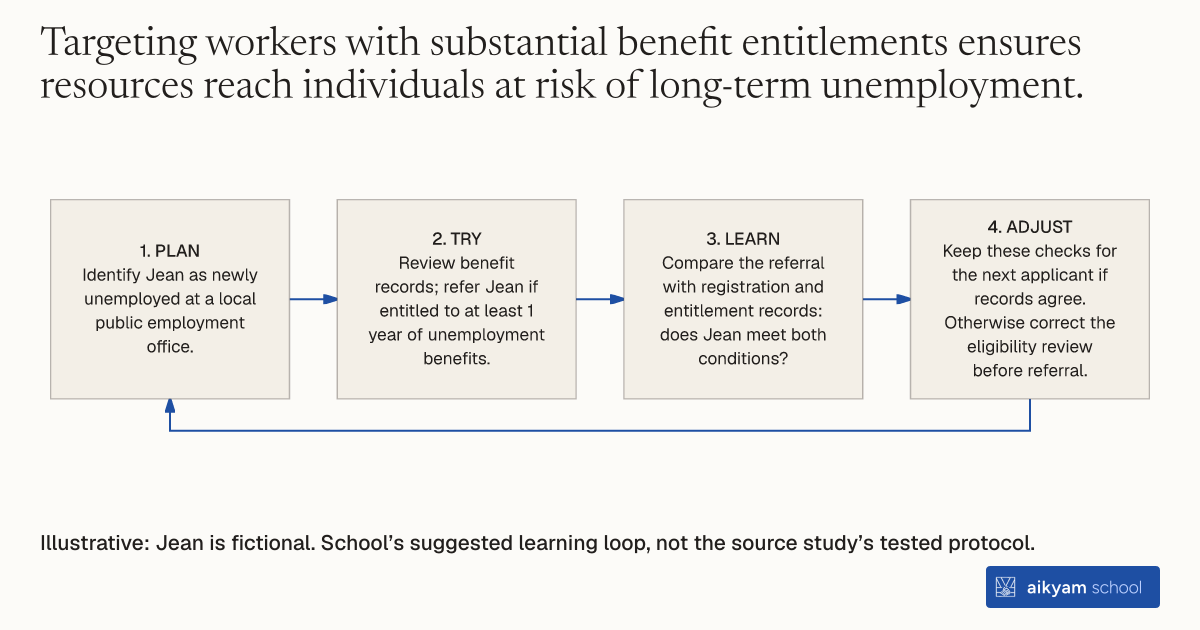
Try, learn and adjust
Check eligibility before counselling referral
- Plan: Identify Jean as newly unemployed at a local public employment office.
- Try: Review benefit records; refer Jean if entitled to at least 1 year of unemployment benefits.
- Learn: Compare the referral with registration and entitlement records: does Jean meet both conditions?
- Adjust: Keep these checks for the next applicant if records agree. Otherwise correct the eligibility review before referral.
Illustrative: Jean is fictional. School’s suggested learning loop, not the source study’s tested protocol.
See source →School’s suggested learning loop: observe new registration and benefit duration; the loop does not alter evaluation assignment.
How
When to use
Public agencies must target active labor market programs to individuals facing persistent unemployment risk. Unrestricted enrollment can dilute limited counseling resources on short-term unemployed workers who find jobs independently. Eligibility screening identifies workers entering unemployment who possess sufficient benefit entitlement to participate in long-term counseling interventions.
Screen entering unemployed individuals based on benefit entitlement duration to identify candidates for intensive job search counseling.
- Identify individuals registering as newly unemployed at local public employment offices.
- Review administrative records to verify each applicant's entitlement to unemployment benefits.
- Select job seekers who are entitled to receive at least one year of unemployment benefits.
- Refer eligible benefit-entitled candidates to evaluation and counseling enrollment tracks at the start of their unemployment period.
Why it works
Focusing on newly entering unemployed individuals allows early intervention before long-term skill degradation and social network narrowing set in.
Example
ANPE and UNEDIC screened job seekers entering unemployment across 216 public employment offices in four French administrative regions in 2007. They selected nearly 44,000 candidates who were entitled to at least one year of benefits to participate in a twelve-month randomized job counseling evaluation.
About the study
Participants
Nearly 44,000 job seekers entering unemployment and entitled to at least one year of benefits across 216 local public employment offices in four French administrative regions.
Study Design
Randomized controlled trial conducted from January to December 2007 tracking administrative and survey data over 12 months across public intensive, private intensive, and public standard comparison groups.
Results
Screening targeted nearly 44,000 eligible benefit-entitled job seekers, allowing public intensive counseling to increase 6-month job placement probability by 50 percent (10.2 percentage points) and private intensive counseling to increase placement by 22 percent (4.5 percentage points).