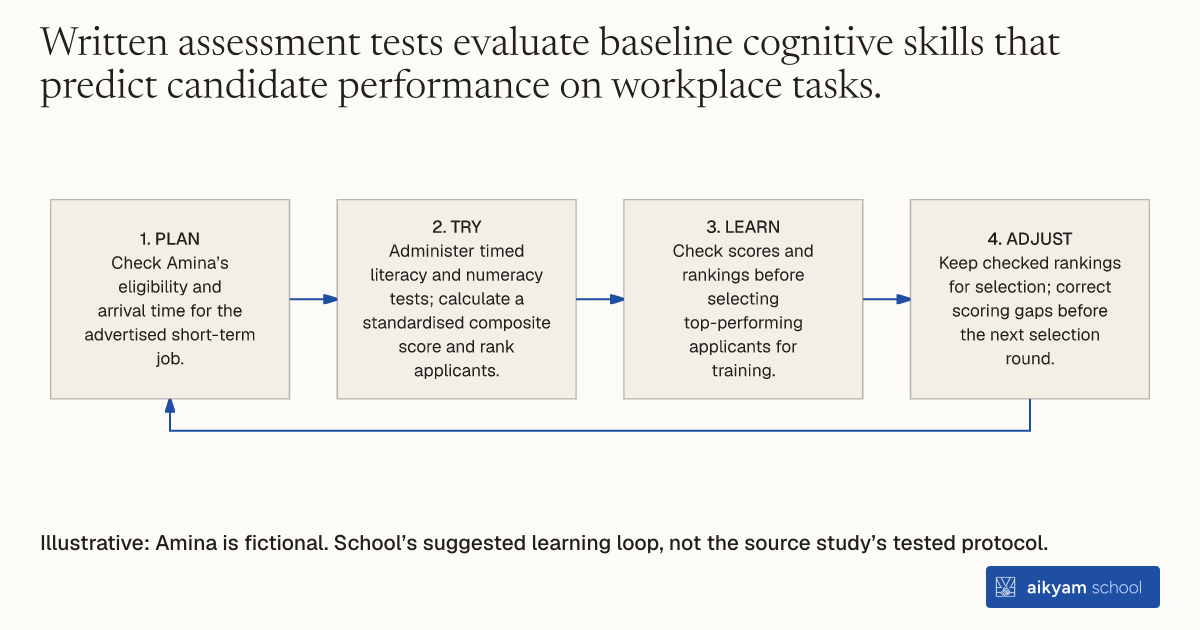
Try, learn and adjust
Check applicant assessment before training
- Plan: Check Amina’s eligibility and arrival time for the advertised short-term job.
- Try: Administer timed literacy and numeracy tests; calculate a standardised composite score and rank applicants.
- Learn: Check scores and rankings before selecting top-performing applicants for training.
- Adjust: Keep checked rankings for selection; correct scoring gaps before the next selection round.
Illustrative: Amina is fictional. School’s suggested learning loop, not the source study’s tested protocol.
See source →School’s suggested learning loop: Observe eligibility, test scores and selection rankings; assessment alone does not establish later employment gains.
How
When to use
Recruiters in low-income labor markets face large applicant pools with unknown candidate skills. Screening job candidates using standardized written tests identifies eligible participants and establishes baseline ability levels. This method serves organizations hiring short-term staff among young job seekers.
Screen job applicants using eligibility filters and timed cognitive assessments.
- Post public job advertisements for short-term positions specifying age and education prerequisites.
- Verify applicant eligibility and punctuality at the assessment site upon candidate arrival.
- Administer timed written assessment tests covering literacy and numeracy in a classroom setting.
- Calculate a standardized composite ability score for each candidate from the test results.
- Select top-performing applicants based on test score rankings to advance to job training.
Why it works
Employers rely on these scores to select qualified candidates when verified past employment records are scarce.
Example
A recruiter in Lilongwe, Malawi screened 554 male job applicants using timed literacy and numeracy tests. The testing team ranked candidates by test performance and invited the 278 top-scoring applicants to proceed to training.
About the study
Participants
554 male job applicants aged 18 and older with completed secondary education in Lilongwe, Malawi, from which 278 were selected for training.
Study Design
Baseline cognitive screening using timed classroom literacy and numeracy tests, converted into z-scores and z-score quintiles.
Results
Test scores strongly predicted selection for hiring, where a 1 standard deviation increase in composite test score increased hiring likelihood by 9.7 percentage points and explained 35.7% of hiring variation.