Try, learn and adjust
Check citizen input at council assemblies
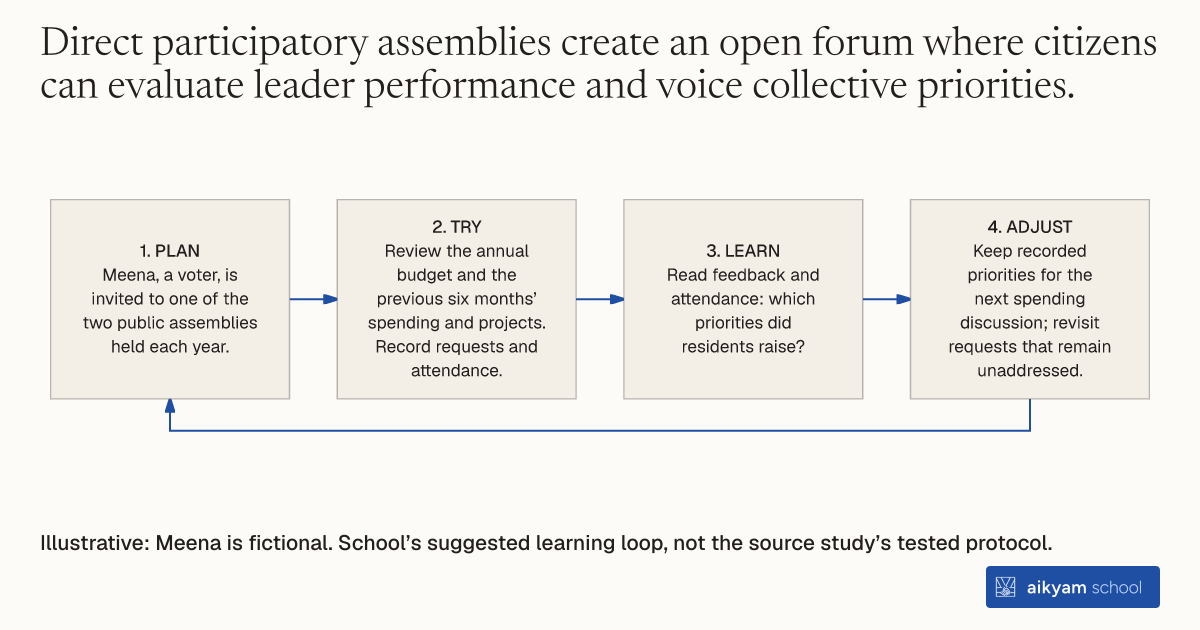
- Plan: Meena, a voter, is invited to one of the two public assemblies held each year.
- Try: Review the annual budget and the previous six months’ spending and projects. Record requests and attendance.
- Learn: Read feedback and attendance: which priorities did residents raise?
- Adjust: Keep recorded priorities for the next spending discussion; revisit requests that remain unaddressed.
Illustrative: Meena is fictional. School’s suggested learning loop, not the source study’s tested protocol.
See source →School’s suggested loop, not a tested source procedure. Observe attendance, requests and spending reports; assembly participation does not prove policy impact.
How
When to use
Local elected councils often make spending decisions without direct public input or citizen oversight. This participatory assembly method solves institutional non-transparency by mandating bi-annual open-floor voter assemblies. It serves local government bodies seeking to increase community engagement and ensure policy accountability among voters.
Organize bi-annual public assemblies for all registered village voters to review municipal budgets and audit local development activities.
- Schedule two open public assemblies each year for all voters and village council leaders across the jurisdiction.
- Present the proposed annual council budget directly to assembled voters for open review and debate.
- Report explicitly on all council expenditures and development projects completed over the preceding six months.
- Establish fixed office hours for the chief council officer to receive individual citizen complaints and requests.
- Record constituent feedback, attendance counts, and specific requests during assembly sessions to guide future council spending.
Why it works
Public scrutiny prevents elite capture and holds elected officials accountable to constituency preferences.
Example
Electoral authorities in West Bengal and Rajasthan mandated bi-annual Gram Samsad assemblies across 265 village councils, tracking voter attendance and participation rates across male and female constituents.
About the study
Participants
Survey of 265 Village Councils across Birbhum district in West Bengal (161 councils) and Udaipur district in Rajasthan (100 hamlets).
Study Design
Randomized policy evaluation comparing voter participation rates in Gram Samsad assemblies between female-reserved councils and male-headed control councils.
Results
Having a female council head increased female assembly attendance from 6.88% to 9.80% in West Bengal, while female attendance reached 20.41% in reserved councils and 24.49% in unreserved councils in Rajasthan.