Try, learn and adjust
Check scheduled village health visits are delivered
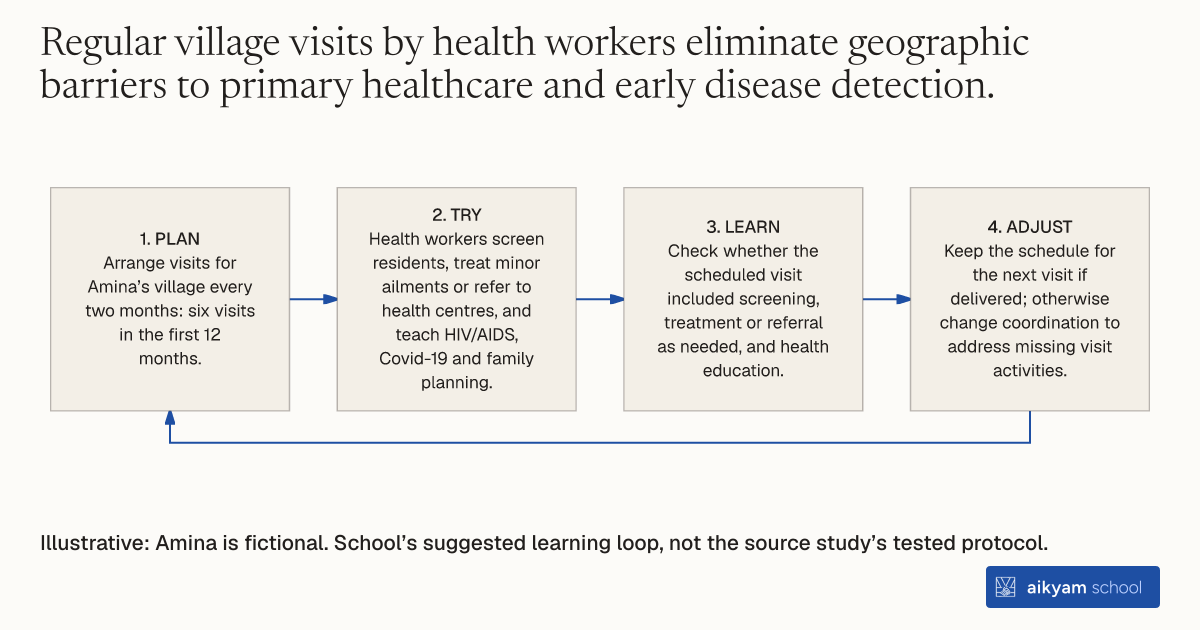
- Plan: Arrange visits for Amina’s village every two months: six visits in the first 12 months.
- Try: Health workers screen residents, treat minor ailments or refer to health centres, and teach HIV/AIDS, Covid-19 and family planning.
- Learn: Check whether the scheduled visit included screening, treatment or referral as needed, and health education.
- Adjust: Keep the schedule for the next visit if delivered; otherwise change coordination to address missing visit activities.
Illustrative: Amina is fictional. School’s suggested learning loop, not the source study’s tested protocol.
See source →School’s suggested, untested learning loop. Observe visit frequency and service coverage. This suggested loop is not a clinical protocol or proof of separate component effects.
How
When to use
Rural households in low-income regions often face limited access to formal health centers, leading to untreated minor illnesses and low awareness of preventive care. Organizing regular community visits by health workers brings primary care and health education directly to rural residents. This approach is intended for isolated agricultural communities with minimal local health infrastructure.
Arrange regular community visits by health workers to provide medical screening, illness treatment, and health education to all village households.
- Partner with health workers to schedule community visits every two months for a total of six visits during the first 12 months of the program.
- Conduct village health screenings to identify minor illnesses among residents.
- Provide direct treatment for minor ailments or refer patients to formal health centers.
- Deliver health education sessions addressing HIV/AIDS, Covid-19, and family planning.
Why it works
Combining medical screenings with community health education lowers overall illness rates and improves physical health.
Example
In rural western Uganda, Raising the Village arranged bi-monthly health worker visits to treated communities, contributing to a 4.1 percentage point drop in child illness and an increase in the physical health index of 0.125 standard deviations.
About the study
Participants
3,852 households across 335 villages in Kagadi and Kyenjojo districts, western Uganda, where 35% of households fall below the \$2.15 PPP daily poverty line post-harvest and 65% during the lean season.
Study Design
Clustered randomized controlled trial across 114 village clusters covering 335 villages, comparing a universal livelihoods program to a pure control group.
Results
Child illness dropped by 4.1 percentage points (p < 0.05), the physical health index increased by 0.125 standard deviations (p < 0.01), and days unable to work due to sickness fell by 0.880 days per month (p < 0.01).