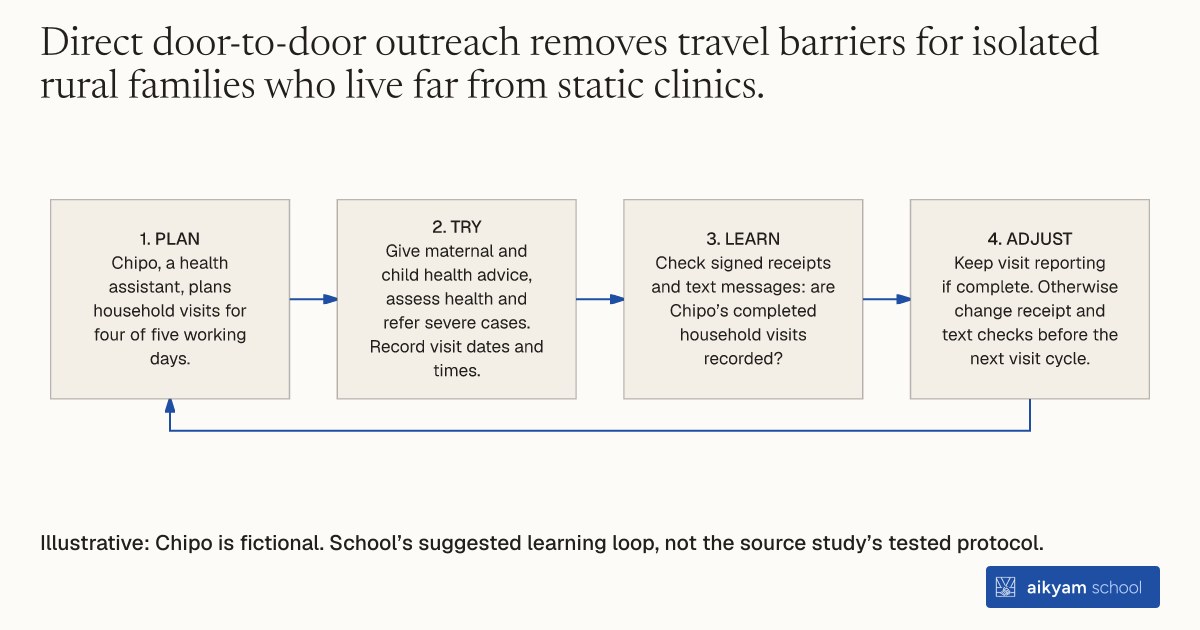
Try, learn and adjust
Check home visits are recorded
- Plan: Chipo, a health assistant, plans household visits for four of five working days.
- Try: Give maternal and child health advice, assess health and refer severe cases. Record visit dates and times.
- Learn: Check signed receipts and text messages: are Chipo’s completed household visits recorded?
- Adjust: Keep visit reporting if complete. Otherwise change receipt and text checks before the next visit cycle.
Illustrative: Chipo is fictional. School’s suggested learning loop, not the source study’s tested protocol.
See source →School’s suggested, untested learning loop. Observe signed visit receipts, text logs and referrals. This does not establish clinical effects.
How
When to use
Rural communities face limited health post staffing and low access to basic clinical care. Remote households often delay preventive care or skip childhood vaccinations. Community health workers conduct door-to-door visits to deliver primary care, maternal counseling, and facility referrals directly at residences.
Conduct proactive door-to-door household visits to provide preventive health education, assess family health, and issue health facility referrals.
- Community health assistants devote four out of five working days per week to visiting rural households in their assigned catchment areas.
- Health workers carry official receipt books and record visit dates, start times, and end times for every household encounter.
- Health workers deliver maternal and child health counseling, check nutrition practices, and assess immunization status.
- Health workers identify sick community members and refer severe medical cases to the local health center or post.
- Health workers request household signatures on paper receipts and log visit details via text messages sent to central health databases.
Why it works
Regular contact allows health workers to identify health risks early and encourage institutional facility care.
Example
In rural Zambia, 307 Community Health Assistants conducted home visits across 161 health post catchment areas covering low-density rural populations. Recruited health workers completed an average of 319 visits per worker in control areas and 412.86 visits in career treatment areas over 18 months. These visits increased institutional births by 30 percent and child weighings by 22 percent at local health facilities.
About the study
Participants
307 deployed Community Health Assistants serving rural catchment areas (median area 78 square kilometers with 200 households) across 48 districts in Zambia.
Study Design
Cluster-randomized trial tracking 18 months of real-time SMS visit receipt records across treatment and control districts, validated against HMIS administrative records and household surveys.
Results
Health workers in career treatment districts completed 93.86 additional household visits over 18 months relative to control (319.0 control mean, p=0.030). Treatment workers visited 36.34 more unique households (p=0.043) and completed 0.487 more follow-up visits per household (p=0.085) with identical average visit duration (33.7 minutes).