Try, learn and adjust
Check engagement with recurring fact checks
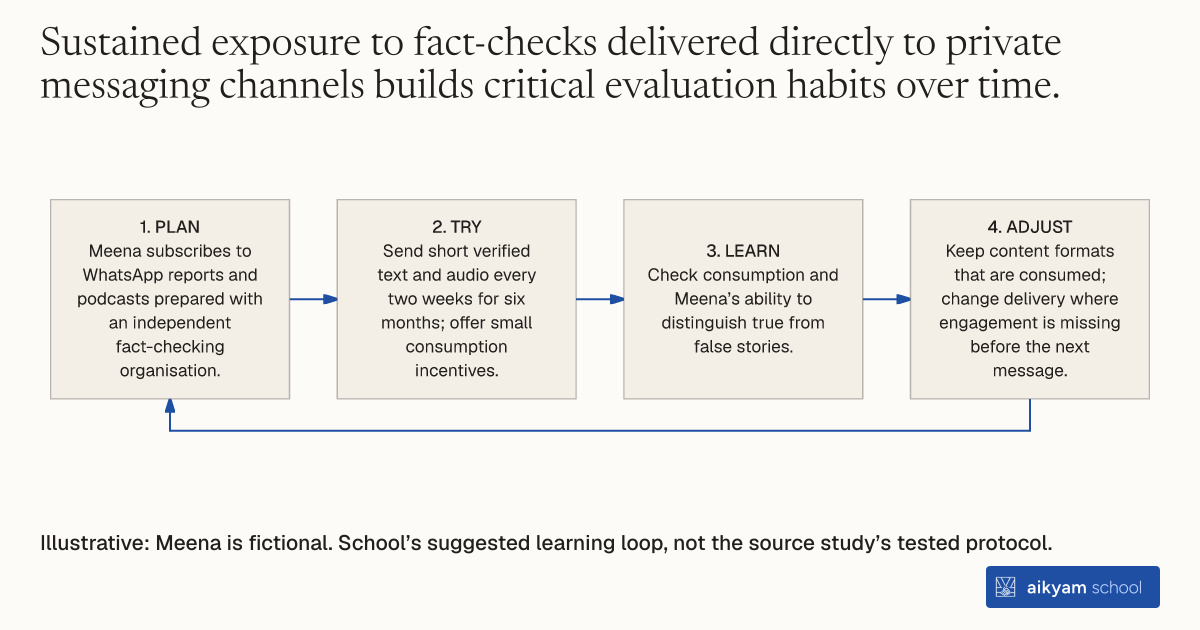
- Plan: Meena subscribes to WhatsApp reports and podcasts prepared with an independent fact-checking organisation.
- Try: Send short verified text and audio every two weeks for six months; offer small consumption incentives.
- Learn: Check consumption and Meena’s ability to distinguish true from false stories.
- Adjust: Keep content formats that are consumed; change delivery where engagement is missing before the next message.
Illustrative: Meena is fictional. School’s suggested learning loop, not the source study’s tested protocol.
See source →School’s suggested learning loop: Observe consumption and news discernment. The trial found little change in overall media consumption patterns.
How
When to use
Citizens in low- and middle-income countries consume political misinformation across closed messaging platforms. News consumers struggle to discern true stories from false statements during election cycles. This method helps media organizations and civil society groups improve citizens' misinformation discernment over time.
Deliver biweekly fact-checking content via WhatsApp messaging and audio podcasts to citizens over a multi-month period.
- Partner with an independent fact-checking organization to produce verified fact-check reports.
- Format fact-checks into short text messages and accessible audio podcasts covering political and public interest topics.
- Establish a WhatsApp distribution network to reach subscribed citizens directly on mobile devices.
- Distribute fact-checking messages and podcasts to participants every two weeks over a six-month period.
- Offer small incentives to encourage subscribers to consume the fact-checking materials.
- Evaluate participants' ability to distinguish between true and false news stories.
Why it works
Providing small incentives increases engagement with fact-checking content.
Example
In South Africa, researchers partnered with Africa Check to deliver biweekly text messages and podcasts via WhatsApp over six months, which increased citizens' ability to discern between true and false stories.
About the study
Participants
Subscribed news consumers across South Africa.
Study Design
Randomized field experiment evaluating biweekly WhatsApp fact-checking messages and podcasts delivered over six months, with tested incentives for consumption.
Results
Increased citizens' ability to discern between true and false stories, had little effect on overall media consumption patterns, and found small incentives helpful in inducing people to consume fact-checks.