Try, learn and adjust
Check access to savings and insurance services
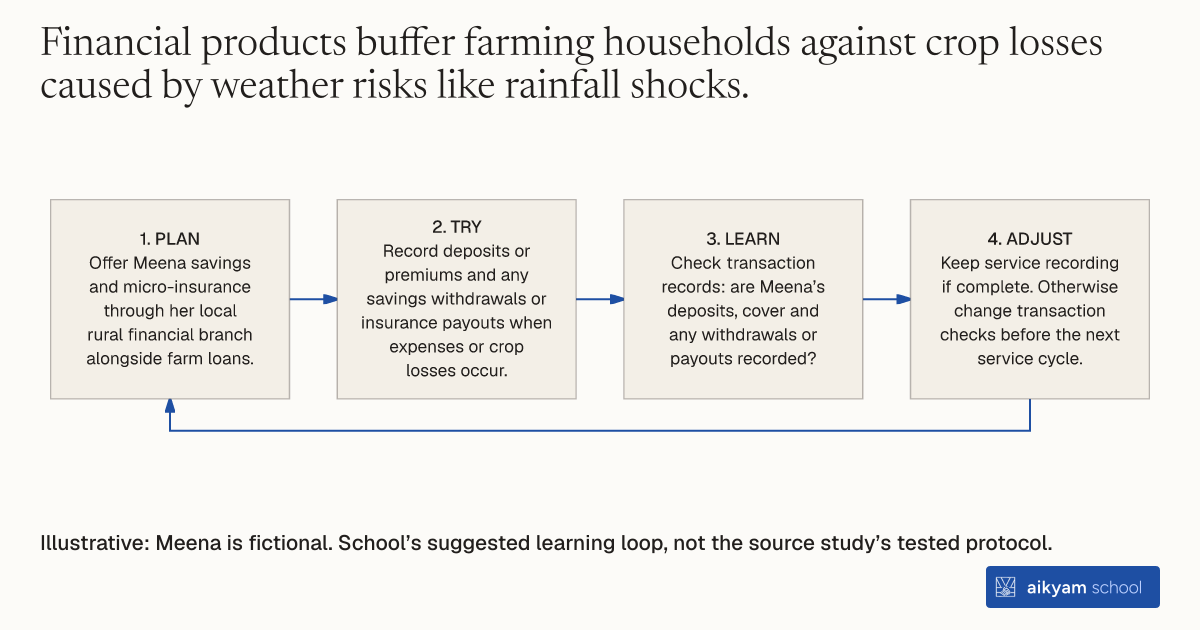
- Plan: Offer Meena savings and micro-insurance through her local rural financial branch alongside farm loans.
- Try: Record deposits or premiums and any savings withdrawals or insurance payouts when expenses or crop losses occur.
- Learn: Check transaction records: are Meena’s deposits, cover and any withdrawals or payouts recorded?
- Adjust: Keep service recording if complete. Otherwise change transaction checks before the next service cycle.
Illustrative: Meena is fictional. School’s suggested learning loop, not the source study’s tested protocol.
See source →School’s suggested, untested learning loop. Observe savings, premiums, withdrawals and payouts. Impact findings are forthcoming; no safety-net effect is assumed.
How
When to use
Agricultural production exposes rural farmers to weather shocks and unexpected financial expenses. Unmitigated risk deters smallholder farmers in Tamil Nadu from investing in productive technology. Offering financial products like savings and insurance creates a safety net that protects farming households against severe crop loss.
Deliver financial safety net products including insurance and savings accounts through local rural financial service branches.
- Financial institutions open local branches in rural communities across Tamil Nadu.
- Field staff offer formal micro-insurance policies and savings accounts alongside agricultural loans.
- Farmers deposit funds into savings accounts or pay small insurance premiums to manage production risks.
- Financial institutions disburse insurance payouts or savings withdrawals when unexpected expenses or crop losses occur.
Why it works
Providing a financial safety net gives farmers confidence to make productive long-term agricultural investments.
Example
Pudhuaaru, Vellaaru, and Thenaaru Kshetriya Grameen Financial Services offered savings and insurance products to 4,500 to 5,500 rural households in Tamil Nadu to buffer agricultural production risks.
About the study
Participants
4,500 to 5,500 households served by 100 to 120 planned rural financial service branches in Thanjavur, Tamil Nadu, India.
Study Design
Phased randomized controlled trial comparing catchment areas of 50 to 60 early branch locations with paired two-year delayed control branches evaluated through baseline and endline household surveys.
Results
Formal credit access was 27 percent in 2003 with per capita income at US\$1,271 in 2008, while specific technology adoption and safety net impacts are listed as forthcoming.