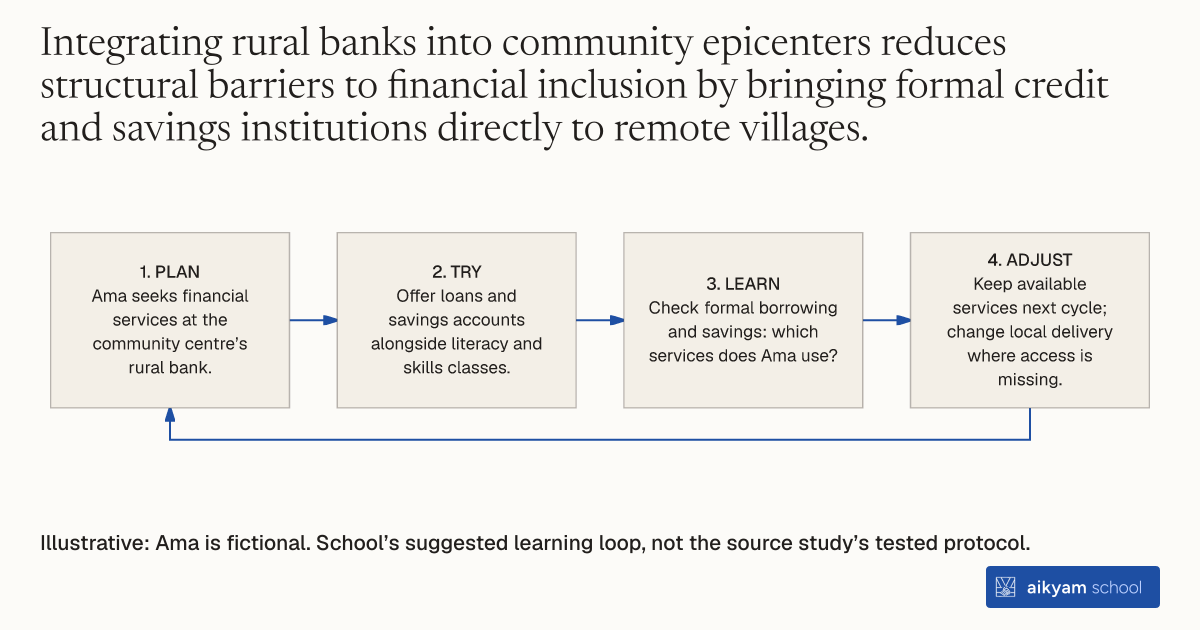
Try, learn and adjust
Check local access to loans and savings
- Plan: Ama seeks financial services at the community centre’s rural bank.
- Try: Offer loans and savings accounts alongside literacy and skills classes.
- Learn: Check formal borrowing and savings: which services does Ama use?
- Adjust: Keep available services next cycle; change local delivery where access is missing.
Illustrative: Ama is fictional. School’s suggested learning loop, not the source study’s tested protocol.
See source →School’s suggested learning loop: Observe access to formal borrowing and savings. The wider programme showed no significant overall savings or enterprise profit effect.
How
When to use
Rural households in developing regions often lack access to formal banking, savings services, and credit to invest in livelihoods. Community-based microfinance and savings programs establish rural financial facilities within community epicenter hubs to deliver loans and financial services. The method serves rural community members seeking formal credit and savings options in underserved areas.
Establish rural banking and microfinance services within a community center to provide credit and financial access.
- Construct a multi-purpose epicenter community center that includes dedicated space for a rural bank.
- Provide financial support and seed funding to initiate microfinance programs and savings operations.
- Offer formal loan products and savings accounts to community members through the center's rural bank.
- Deliver microfinance programming alongside complementary literacy and skill-building classes at the epicenter.
- Manage credit offerings locally to expand access to formal borrowing across rural village groupings.
Example
The Hunger Project funded and operated microfinance and rural banking programs within community epicenters across 51 assigned village groupings in Eastern Ghana. In mobilized epicenter communities, formal borrowing increased with households reporting higher loan amounts and reduced local interest rates.
About the study
Participants
2,744 households across 97 village groupings in 13 districts of Eastern Ghana.
Study Design
Randomized evaluation using public lotteries to assign 51 village groupings to treatment and 46 to control over a five-year period.
Results
Program mobilization increased the credit subindex by 0.556 standard deviations and formal borrowing by 5.3 percentage points, but had no significant overall effect on household savings (0.116 standard deviations) or enterprise profits (-80.3 GHC).