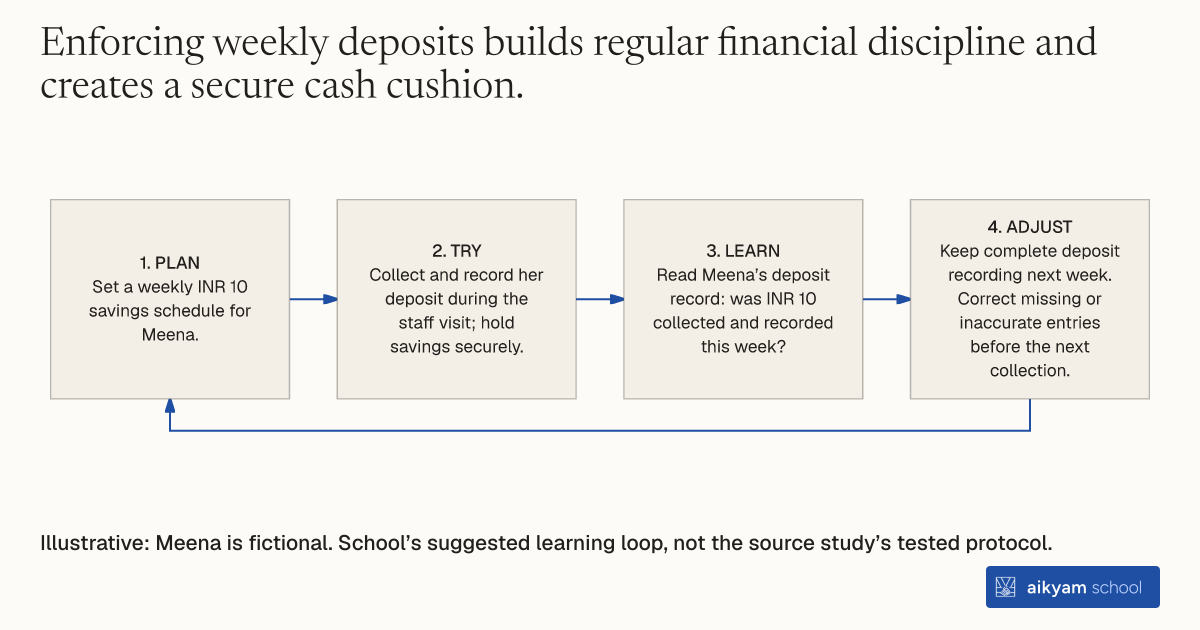
Try, learn and adjust
Check weekly savings deposits
- Plan: Set a weekly INR 10 savings schedule for Meena.
- Try: Collect and record her deposit during the staff visit; hold savings securely.
- Learn: Read Meena’s deposit record: was INR 10 collected and recorded this week?
- Adjust: Keep complete deposit recording next week. Correct missing or inaccurate entries before the next collection.
Illustrative: Meena is fictional. School’s suggested learning loop, not the source study’s tested protocol.
See source →School’s suggested, untested loop. Observe weekly savings amounts and records; wider programme outcomes do not establish the savings component’s effect.
How
When to use
Extremely poor households often lack safe places to store money or build reserves for emergencies. Without regular savings habits, families remain vulnerable to economic shocks and cannot invest in microenterprises. Program managers mandate small weekly cash deposits among ultra-poor participants to cultivate financial discipline.
Require ultra-poor participants to make regular weekly cash savings deposits throughout the program period.
- Establish a regular weekly schedule for collecting savings from each participating household.
- Direct participants to set aside INR 10 each week from household income or cash transfers.
- Collect and record the mandatory INR 10 deposit during weekly staff visits.
- Hold savings securely to ensure financial discipline and liquidity for future household needs.
Why it works
Accumulated savings shield vulnerable families from unexpected income shocks and support microenterprise expansion.
Example
In West Bengal, India, Bandhan required 514 ultra-poor households to save INR 10 per week during an 18-month program. One year after program completion, participating households achieved higher monthly consumption of 73 US dollars compared to 67 US dollars in the comparison group.
About the study
Participants
978 ultra-poor households in Murshidabad, West Bengal, India, consuming 40 US dollars per month on average.
Study Design
Randomized controlled trial evaluating 514 treatment households against 464 comparison households across ten years.
Results
Average total monthly consumption reached 73 US dollars thirty months after asset transfer compared to 67 US dollars in comparison households, representing a 9 percent increase.