Try, learn and adjust
Check business purpose before loan approval
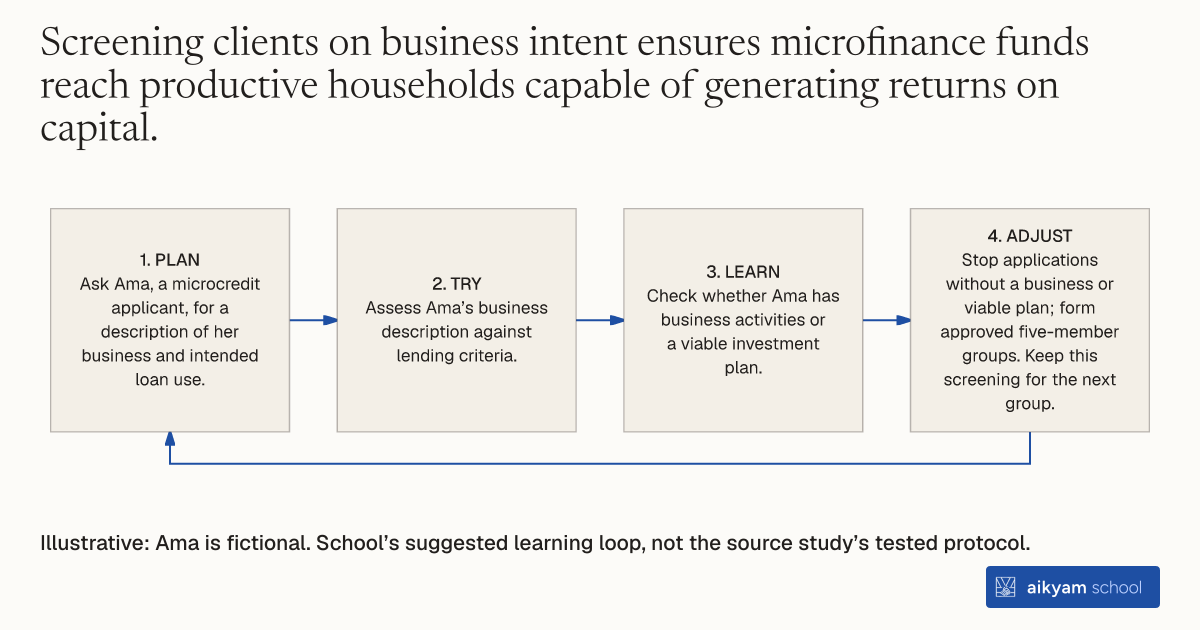
- Plan: Ask Ama, a microcredit applicant, for a description of her business and intended loan use.
- Try: Assess Ama’s business description against lending criteria.
- Learn: Check whether Ama has business activities or a viable investment plan.
- Adjust: Stop applications without a business or viable plan; form approved five-member groups. Keep this screening for the next group.
Illustrative: Ama is fictional. School’s suggested learning loop, not the source study’s tested protocol.
See source →School’s suggested, untested learning loop. Observe business descriptions and loan purpose before approval and disbursal.
How
When to use
Low-income female microfinance applicants in urban neighborhoods seek uncollateralized credit for household microenterprises. Lenders want to ensure loan capital targets entrepreneurial households rather than personal consumption uses. Administering a targeted business screening protocol allows loan officers to select clients with active or intended commercial enterprises.
Screen female microcredit applicants using business descriptions and loan purpose evaluations prior to group approval and loan disbursal.
- Conduct community outreach to recruit low-income women interested in microfinance borrowing.
- Require applicants to submit formal business descriptions specifying the intended commercial use of loan capital.
- Direct loan officers to evaluate applicant business descriptions against institutional lending criteria.
- Screen out applicants who lack business activities or viable microenterprise investment plans.
- Form approved five-member borrower groups designated for loan disbursal.
Why it works
Filtering applicants by loan purpose aligns client capabilities with institutional lending requirements and reduces unhedged borrowing risk.
Example
Village Financial Services loan officers screened low-income female applicants across Kolkata, India by requiring detailed business descriptions, selecting 845 clients across 169 five-member groups where 78 percent operated baseline microenterprises.
About the study
Participants
845 low-income female microfinance clients in 169 loan groups in Kolkata, India.
Study Design
Field randomized controlled trial evaluating microcredit impacts among clients selected through MFI business purpose screening rules.
Results
Screening low-income applicants on loan purpose yielded a client pool where 78 percent had baseline microenterprises, enabling 91 percent of clients to spend loan capital on business expenditures.