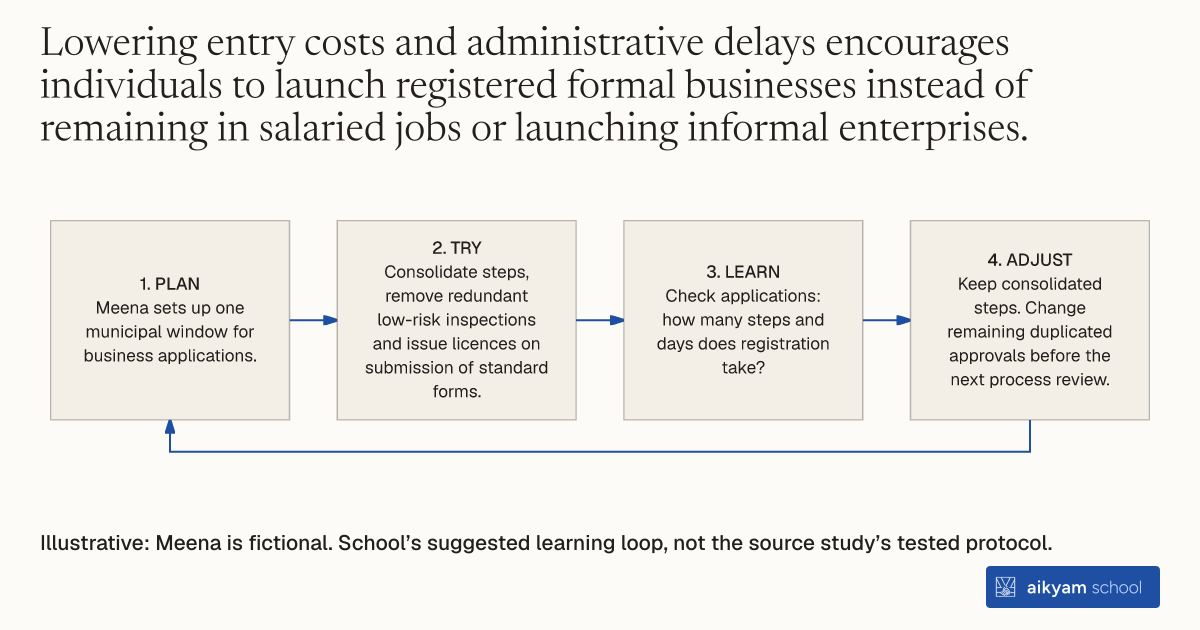
Try, learn and adjust
Check the business registration process is shorter
- Plan: Meena sets up one municipal window for business applications.
- Try: Consolidate steps, remove redundant low-risk inspections and issue licences on submission of standard forms.
- Learn: Check applications: how many steps and days does registration take?
- Adjust: Keep consolidated steps. Change remaining duplicated approvals before the next process review.
Illustrative: Meena is fictional. School’s suggested learning loop, not the source study’s tested protocol.
See source →Observe registration steps, processing days and licence issue. School suggests this learning loop; it is not the source’s tested procedure.
How
When to use
Complex administrative requirements and lengthy procedures for opening a business create high initial barriers for entrepreneurs. This situation deters new business creation and encourages potential owners to operate informally. It applies to municipal authorities seeking to stimulate new business registration by streamlining startup procedures.
Streamline and consolidate administrative procedures for opening new business enterprises.
- Establish a single municipal administrative window to process business registration applications.
- Reduce the total number of days and bureaucratic steps required to secure an operating permit.
- Eliminate redundant inspections and approval requirements for low-risk commercial activities.
- Issue immediate operating licenses upon submission of standardized registration forms.
Example
In Mexico, a reform that simplified the bureaucracy for starting a business increased the number of registered companies, driven by former salaried workers launching new formal businesses.
Source
See source →Evidence in Labor Market Policies and Implications for Brazil: Informality
Copyright © 2025 Inter-American Development Bank.
Full source notice
Copyright © 2025 Inter-American Development Bank ("IDB"). This work is subject to a Creative Commons license CC BY 3.0 IGO (https://creativecommons.org/licenses/by/3.0/igo/legalcode). The terms and conditions indicated in the URL link must be met and the respective recognition must be granted to the IDB. Further to section 8 of the above license, any mediation relating to disputes arising under such license shall be conducted in accordance with the WIPO Mediation Rules. Any dispute related to the use of the works of the IDB that cannot be settled amicably shall be submitted to arbitration pursuant to the United Nations Commission on International Trade Law (UNCITRAL) rules. The use of the IDB's name for any purpose other than for attribution, and the use of IDB's logo shall be subject to a separate written license agreement between the IDB and the user and is not authorized as part of this license. Note that the URL link includes terms and conditions that are an integral part of this license.