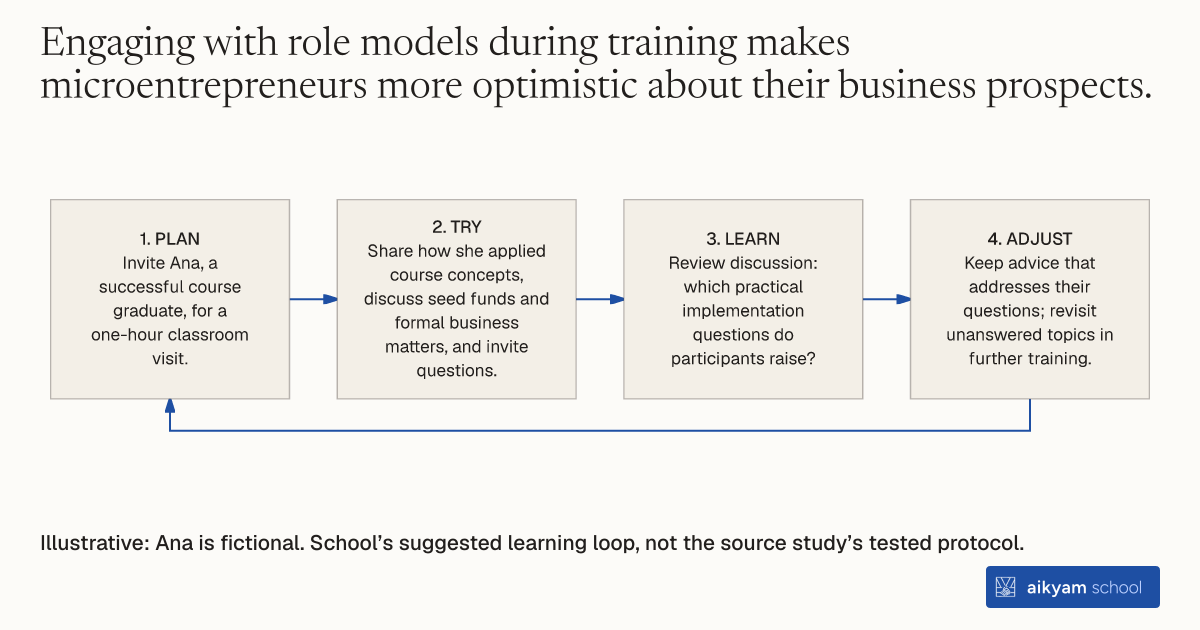
Try, learn and adjust
Check peer visits include practical discussion
- Plan: Invite Ana, a successful course graduate, for a one-hour classroom visit.
- Try: Share how she applied course concepts, discuss seed funds and formal business matters, and invite questions.
- Learn: Review discussion: which practical implementation questions do participants raise?
- Adjust: Keep advice that addresses their questions; revisit unanswered topics in further training.
Illustrative: Ana is fictional. School’s suggested learning loop, not the source study’s tested protocol.
See source →School’s suggested loop, not a tested source procedure. Observe the visit, practical advice and discussion; optimism alone does not prove income gains.
How
When to use
Microentrepreneurs in low-income populations often face motivational bottlenecks and lack confidence to execute new business practices after attending training courses. Incorporating visits from former successful students provides relatable social proof that inspires participants to act. This approach serves informal microentrepreneurs, especially those running younger businesses or with limited prior experience.
Integrate brief interactive visits from successful course alumni into standard classroom training sessions for informal microentrepreneurs.
- Recruit former course graduates who run successful businesses earning roughly US\$3,000 per month.
- Schedule a one-hour visit by a graduate role model during a standard classroom training session.
- Have the role model share personal stories detailing how they applied training concepts to grow their business.
- Direct the role model to offer actionable advice on accessing seed capital funds and handling formal business topics.
- Facilitate interactive discussion between class participants and the visiting role model to boost participant optimism and self-efficacy.
Why it works
This confidence boost encourages participants to make active investment decisions and register their enterprises.
Example
In Chile, Simón de Cirene integrated one-hour visits by former course graduates earning US\$3,000 per month into 34 training courses reaching low-income microentrepreneurs, 92 percent of whom were women. One year after the program, participants who attended a role model session earned US\$279 per month in household income compared to US\$228 in the comparison group, representing an increase of about 15 percent.
About the study
Participants
1,712 participants in 66 training courses across Chile, 92 percent female, with half having graduated high school and 30 percent holding technical or university education.
Study Design
A two-stage randomized evaluation where 34 courses were assigned to receive a role model session and 32 courses served as a comparison group, measuring outcomes through administrative data and phone surveys one year after program start.
Results
Role model sessions increased monthly household income by US\$30 to US\$50 (about 15 percent) from a baseline comparison group average of US\$228, while significantly increasing business continuity, tax registration, and seed fund applications.