Research procedure
Compare piece rates and monitoring costs
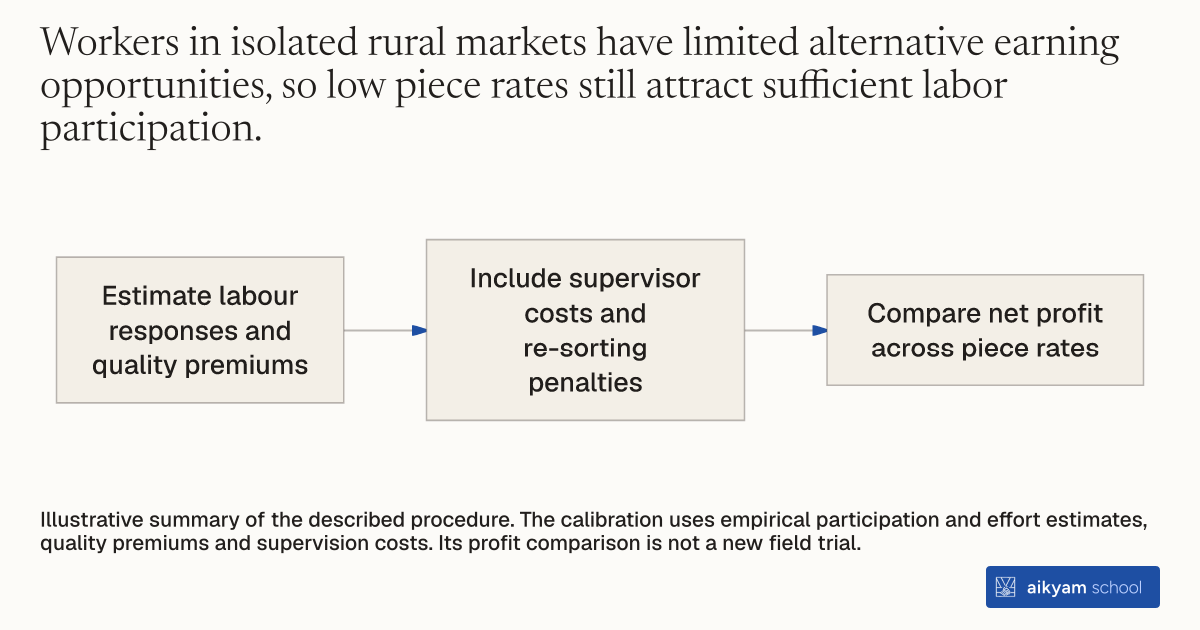
- Estimate labour responses and quality premiums
- Include supervisor costs and re-sorting penalties
- Compare net profit across piece rates
Illustrative summary of the described procedure. The calibration uses empirical participation and effort estimates, quality premiums and supervision costs. Its profit comparison is not a new field trial.
See source →How
When to use
Employers operating in rural labor markets with few competing firms face decisions about setting piece rates and supervision levels. Offering high rates raises labor costs without driving large gains in daily output per worker. Calibrating pay rates against monitoring costs allows employers to maximize profit per unit produced.
Maximize employer profits in monopsonistic labor markets by pairing minimum piece rates with mandatory quality monitoring.
- Calculate local labor participation elasticities and output effort elasticities across offered piece rates.
- Estimate the market price premium for high-quality sorted goods versus unsorted raw goods.
- Determine the daily wage cost of hiring quality supervisors to conduct spot-checks.
- Set the piece rate at the lowest rate that achieves required labor participation targets.
- Introduce randomized spot-checks with unpaid re-sorting penalties to maintain product quality.
- Combine minimum piece rates with strict quality controls to capture the highest net economic surplus.
Why it works
Forcing workers to fix quality flaws without pay shifts the burden of quality control onto laborers while saving employer wage costs.
Example
Researchers calibrated profit scenarios using field data from 612 casual laborers in rural Malawi sorting 50 kg bags of beans. Market buyers paid a premium of up to 4,000 MWK for well-sorted bean bags compared to unsorted bags. Offering the lowest piece rate of 5 MWK alongside strict quality monitoring generated nearly 50 percent higher profit per bag from male workers compared to unmonitored contracts.
About the study
Participants
Calibration based on 612 contracted workers across 1,461 worker-day observations in 12 villages in rural Malawi.
Study Design
Theoretical profit optimization model using empirical field estimates of effort elasticity (0.06), participation elasticity (0.58), supervisor wages, and bean market price differentials.
Results
The highest overall profit per bag occurs at the lowest piece rate of 5 MWK combined with quality monitoring, increasing employer profits from male labor by nearly 50 percent relative to unmonitored contracts.