Research procedure
Compare official candidate disclosures
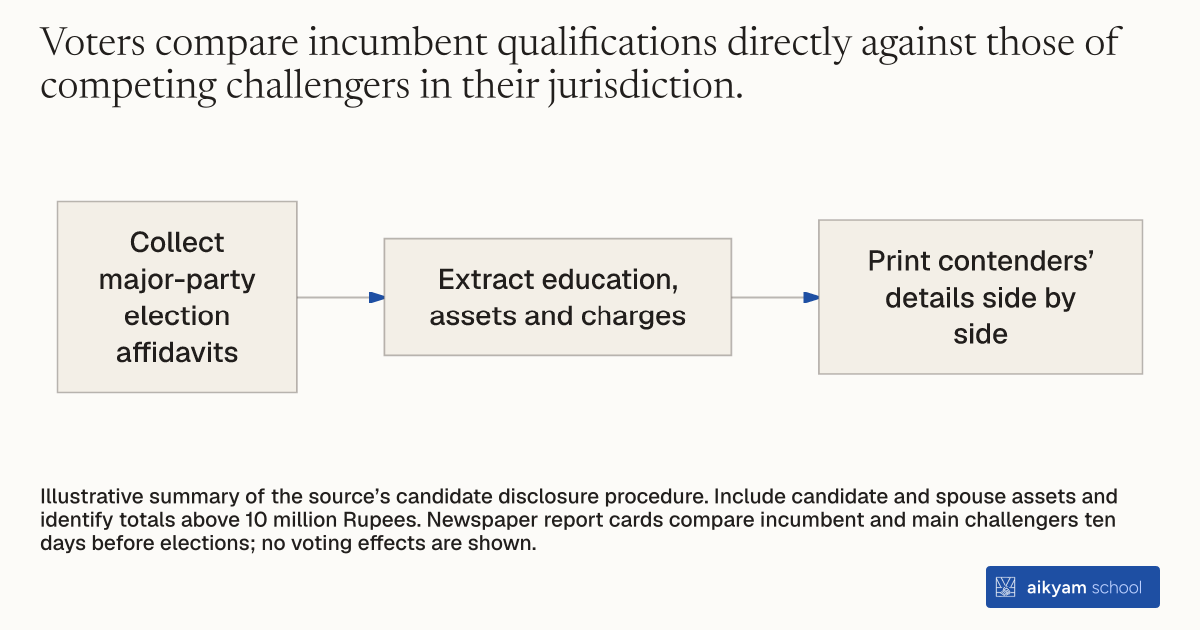
- Collect major-party election affidavits
- Extract education, assets and charges
- Print contenders’ details side by side
Illustrative summary of the source’s candidate disclosure procedure. Include candidate and spouse assets and identify totals above 10 million Rupees. Newspaper report cards compare incumbent and main challengers ten days before elections; no voting effects are shown.
See source →How
When to use
Voters in low-income democracies often lack verified background information about political candidates. Official candidate self-declarations submitted under legal mandates usually remain unread in government archives. Non-governmental organisations compile and publish candidate background data to help citizens compare contenders before voting.
Publish official candidate background disclosures from election affidavits to enable direct evaluation among competing contenders.
- NGO partners collect pre-election affidavits filed with the Election Commission by candidates from major contesting parties.
- Extract data on candidate educational attainment, noting whether each candidate attended college.
- Calculate total assets owned by each candidate and spouse, identifying candidates with assets exceeding 10 million Rupees.
- Record all pending criminal charges disclosed in each candidate's affidavit.
- Print candidate background details for the incumbent and main challengers side by side in newspaper report cards ten days before elections.
Why it works
Evaluating candidate attributes allows voters to benchmark quality and penalise relatively less qualified incumbents.
Example
An NGO network compiled qualification affidavits for candidates across three major parties in ten Delhi jurisdictions, revealing that 70 percent of incumbents were crorepatis and 20 percent had not attended college.
About the study
Participants
775 polling stations serving low-income slum households in 10 jurisdictions in Delhi, India, with average household income around 1 dollar a day per person.
Study Design
Randomized controlled trial comparing 200 treatment slums receiving candidate qualification disclosures against 575 control slums.
Results
Incumbents who were richer or less educated than their challengers received fewer votes, and an increase in average challenger qualifications decreased incumbent vote share by 8.0 percentage points.