Try, learn and adjust
Check doorstep delivery of report cards
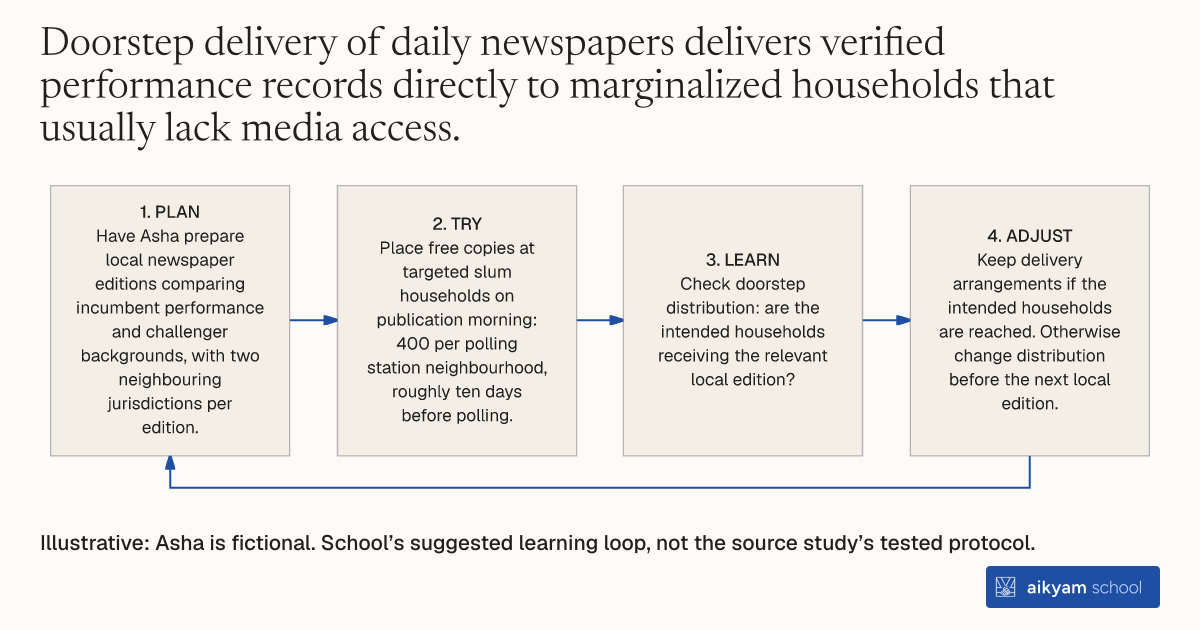
- Plan: Have Asha prepare local newspaper editions comparing incumbent performance and challenger backgrounds, with two neighbouring jurisdictions per edition.
- Try: Place free copies at targeted slum households on publication morning: 400 per polling station neighbourhood, roughly ten days before polling.
- Learn: Check doorstep distribution: are the intended households receiving the relevant local edition?
- Adjust: Keep delivery arrangements if the intended households are reached. Otherwise change distribution before the next local edition.
Illustrative: Asha is fictional. School’s suggested learning loop, not the source study’s tested protocol.
See source →School’s suggested, untested loop: observe edition relevance and household delivery; this check does not establish voting effects.
How
When to use
Slum dwellers in urban democracies frequently lack accessible, comparative information on local politician performance. Traditional media outlets rarely reach marginalized low-income voters with localized performance disclosures before elections. Delivering report cards in daily vernacular newspapers directly to informal settlement households overcomes information barriers.
Distribute localized politician performance report cards directly to slum households using daily vernacular newspaper distribution networks before elections.
- Partner with a widely read vernacular daily newspaper to publish special jurisdiction-specific report card editions during the election campaign.
- Include comparative performance metrics for the incumbent legislator and background disclosures for major party challengers in each report card edition.
- Feature report cards for two neighboring electoral jurisdictions in each edition to enable cross-jurisdiction performance benchmarking.
- Deploy field teams to place a free copy of the vernacular newspaper on the doorstep of every targeted slum household on publication morning.
- Deliver 400 newspapers per targeted polling station neighborhood roughly ten days before polling day.
Why it works
Publishing disclosures in familiar vernacular newspapers lends credibility to governance data and encourages household discussion.
Example
NGO workers delivered 80,000 free copies of Dainik Hindustan containing report cards directly to doorsteps across 200 slum neighborhoods in Delhi between November 20 and 25, 2008.
About the study
Participants
775 polling stations serving low-income slum households in 10 jurisdictions in Delhi, India, with average household income around 1 dollar a day per person.
Study Design
Randomized controlled trial comparing 200 treatment slums receiving doorstep report card delivery against 575 control slums.
Results
Delivering report cards increased voter turnout by 3.5 percent, reduced cash-based vote-buying by 19 percentage points, and increased vote share for high-performing incumbents by 6.9 percentage points.