Try, learn and adjust
Check posted and submitted vote totals
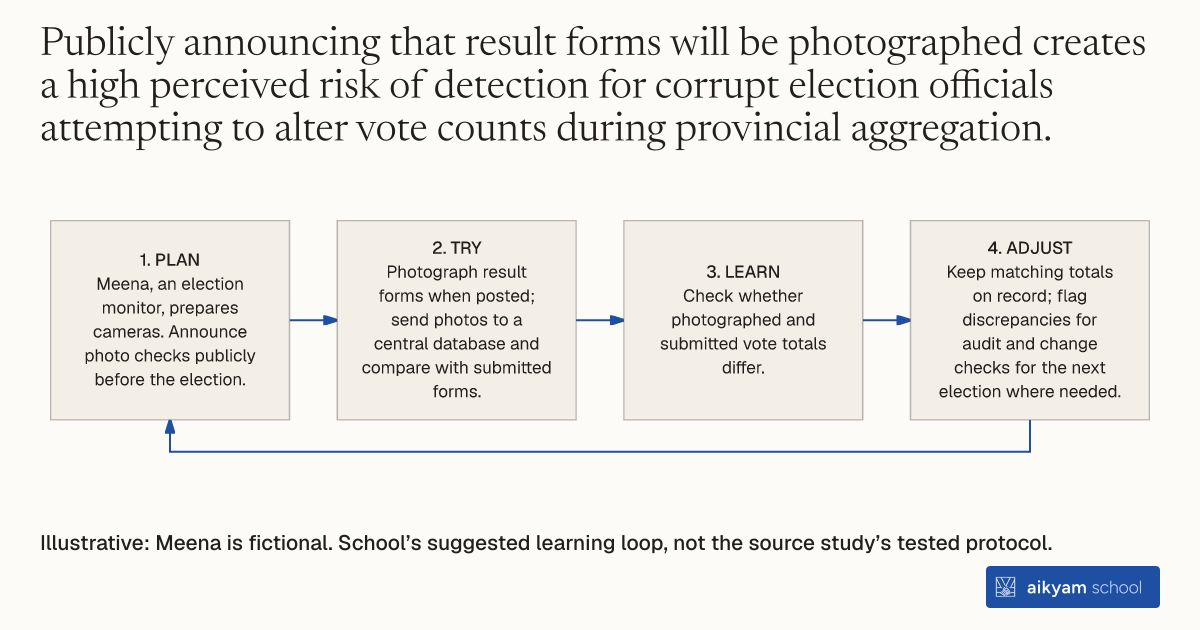
- Plan: Meena, an election monitor, prepares cameras. Announce photo checks publicly before the election.
- Try: Photograph result forms when posted; send photos to a central database and compare with submitted forms.
- Learn: Check whether photographed and submitted vote totals differ.
- Adjust: Keep matching totals on record; flag discrepancies for audit and change checks for the next election where needed.
Illustrative: Meena is fictional. School’s suggested learning loop, not the source study’s tested protocol.
See source →School’s suggested, untested loop. Observe posted forms, submitted forms and flagged discrepancies; this loop does not establish fraud reduction.
How
When to use
Election officials or corrupt actors alter vote totals after polling places close during aggregation at regional centers. Election materials and posted result forms face tampering or destruction before official counts complete. This method protects the integrity of vote counts for election administrators and monitoring organizations.
Photograph posted declaration of results forms at polling centers to compare them directly against forms submitted to national aggregation centers.
- Deploy election monitors equipped with digital cameras to targeted polling centers on election day.
- Instruct monitors to photograph the official declaration of results forms as soon as polling staff post them publicly at each polling center.
- Announce publicly before the election that result forms at polling centers will be photographed and compared to counts submitted at higher administrative levels.
- Transport the photographic records to a centralized database.
- Compare the vote counts shown in the center photos against the physical forms received at the provincial aggregation count.
- Identify and flag discrepancies or altered vote totals for official audit.
Why it works
Creating an independent visual record of initial tallies prevents actors from modifying submitted forms without triggering clear evidence of fraud.
Example
In Afghanistan, researchers tested camera monitoring during an election by photographing declaration of results forms posted at polling centers and comparing them to forms submitted to the national count. The intervention reduced the damage of election materials by 11 percentage points from a base of 19 percent in the comparison group and decreased votes changed during provincial aggregation.
About the study
Participants
Polling centers and election staff across Afghanistan during a national election.
Study Design
Randomized evaluation comparing polling centers assigned to camera monitoring and program announcements against unmonitored comparison polling centers.
Results
Reduced damage of election materials by 11 percentage points from a base of 19 percent in the comparison group, reduced the number of votes changed during provincial aggregation, and reduced fraud in neighboring polling stations.