Try, learn and adjust
Check career-focused recruitment materials
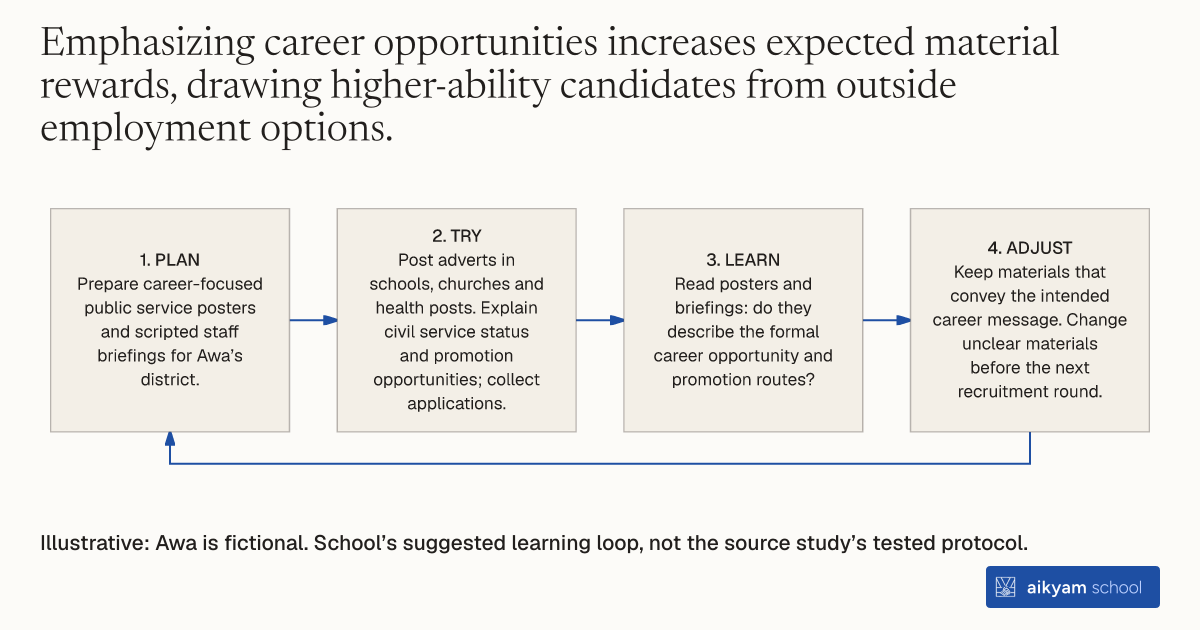
- Plan: Prepare career-focused public service posters and scripted staff briefings for Awa’s district.
- Try: Post adverts in schools, churches and health posts. Explain civil service status and promotion opportunities; collect applications.
- Learn: Read posters and briefings: do they describe the formal career opportunity and promotion routes?
- Adjust: Keep materials that convey the intended career message. Change unclear materials before the next recruitment round.
Illustrative: Awa is fictional. School’s suggested learning loop, not the source study’s tested protocol.
See source →School’s suggested, untested loop. Observe recruitment wording and applications; this does not establish worker performance effects.
How
When to use
Public organizations need to recruit skilled health workers for newly created formal civil service positions in remote areas. Standard recruitment often draws low-skilled candidates or informal volunteers with limited technical abilities. Highlighting career advancement opportunities attracts more talented applicants without lowering prosocial motivation among recruited candidates.
Advertise public service positions using recruitment materials that emphasize civil service career growth and professional promotion.
- District health officials post printed advertisements in local public locations including schools, churches, and community health posts.
- Recruitment posters highlight civil service status and outline promotion opportunities to higher cadres such as nurse, clinical officer, or doctor.
- District health officials present scripted briefings to local health facility staff describing the role as a formal career opportunity.
- Local health centers accept completed job applications from residents aged 18 to 45 who completed secondary school.
- Selection panels shortlist applicants using Grade 12 examination results and local committee endorsements.
Why it works
When local selection panels choose top performers from the applicant pool, the highest-ability recruits retain high levels of prosocial motivation.
Example
The Ministry of Health in Zambia deployed career-focused advertisements across 24 rural districts during a recruitment drive for Community Health Assistants. The drive generated 2,457 total applications across all districts, averaging 7.4 applicants per health post. Selected health workers recruited through career advertisements performed 93.86 additional household visits over 18 months compared to control recruits.
About the study
Participants
1,585 interviewed applicants (71.5 percent farmers, average age 25.7, 29.2 percent female) across 24 treatment districts in rural Zambia where 4.4 percent of the population held secondary school credentials.
Study Design
Randomized controlled trial across 48 districts stratified by province and literacy, comparing career-focused recruitment posters to community-focused control posters while holding post-hire incentives constant.
Results
Career advertisements raised average applicant exam scores from 23.3 to 24.8 (p=0.019) and career motivation from 19 percent to 25 percent (p=0.026). Recruited workers completed 93.86 more household visits over 18 months (p=0.030) and reduced child underweight prevalence by 25 percent (p=0.084).