Try, learn and adjust
Check delivery of the career growth pitch
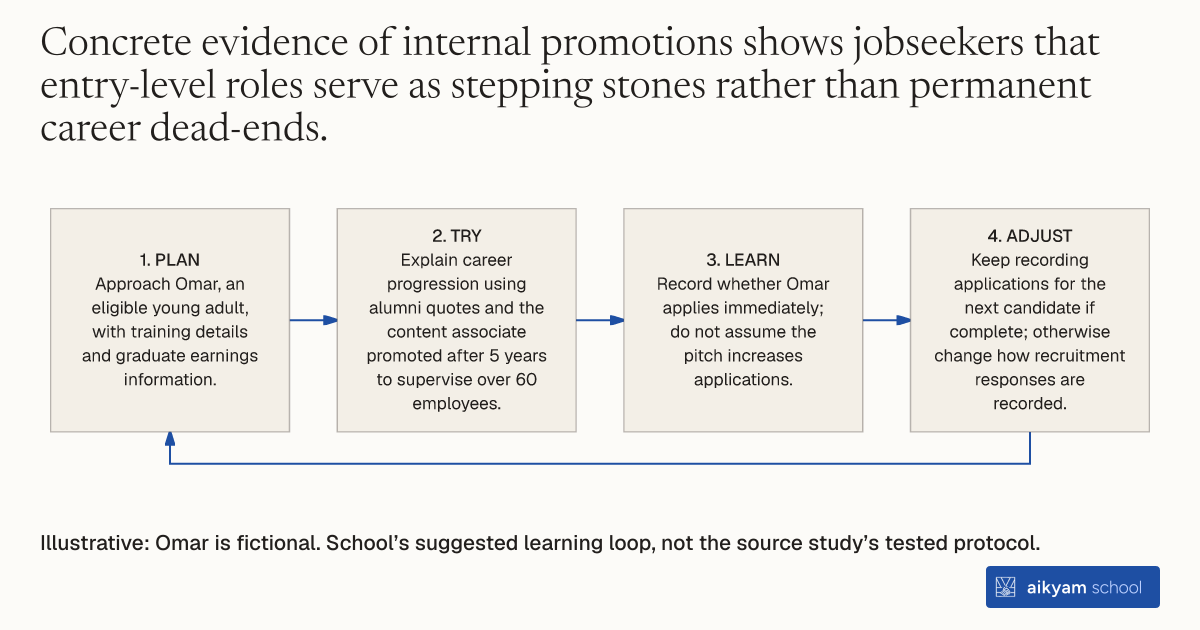
- Plan: Approach Omar, an eligible young adult, with training details and graduate earnings information.
- Try: Explain career progression using alumni quotes and the content associate promoted after 5 years to supervise over 60 employees.
- Learn: Record whether Omar applies immediately; do not assume the pitch increases applications.
- Adjust: Keep recording applications for the next candidate if complete; otherwise change how recruitment responses are recorded.
Illustrative: Omar is fictional. School’s suggested learning loop, not the source study’s tested protocol.
See source →School’s suggested, untested learning loop. Observe applications following the pitch; the study’s average application change was not statistically significant.
How
When to use
Jobseekers often turn down entry-level positions out of fear that the positions represent a professional dead-end. Program managers need an outreach pitch that tackles professional career concerns during recruitment drives. This method addresses career advancement worries by presenting evidence of real graduate promotions.
Deliver a recruitment pitch that pairs baseline job training information with alumni quotes and concrete examples of rapid professional promotion.
- Approach eligible young adults on city streets to present job training opportunities.
- Share core program facts about course location, length, practical curriculum, and average graduate earnings.
- State that although some people think entry-level positions are a professional dead-end, past graduates frequently move up the professional ladder.
- Provide a concrete example of an alumnus who began as a content associate and became a senior content supervisor managing over 60 employees 5 years later.
- Read alumnus quotes emphasizing that their entry-level jobs offered clear room for professional growth.
- Invite the candidate to enroll in the training program immediately.
Why it works
Relatable success stories help jobseekers reframe initial low-status positions as long-term professional investments.
Example
Surveyors delivered the professional stigma pitch to 723 eligible youth in Greater Cairo during street recruitment. The pitch decreased average sign-ups slightly, but increased the share of rich applicants by 62 percent and working applicants by 28 percent relative to control.
About the study
Participants
1,470 eligible unemployed and underemployed youth aged 18 to 35 in Greater Cairo, Egypt.
Study Design
Individual-level randomized field experiment comparing a standard control pitch against a professional stigma testimonial pitch delivered during street marketing.
Results
The professional stigma pitch reduced average application rates by 2.9 percentage points (statistically insignificant), decreased sign-ups by 12.5 percentage points in the bottom machine learning group (p = 0.015), and increased the share of rich applicants by 62 percent (p < 0.01).