Research steps
Give norm information during job offers
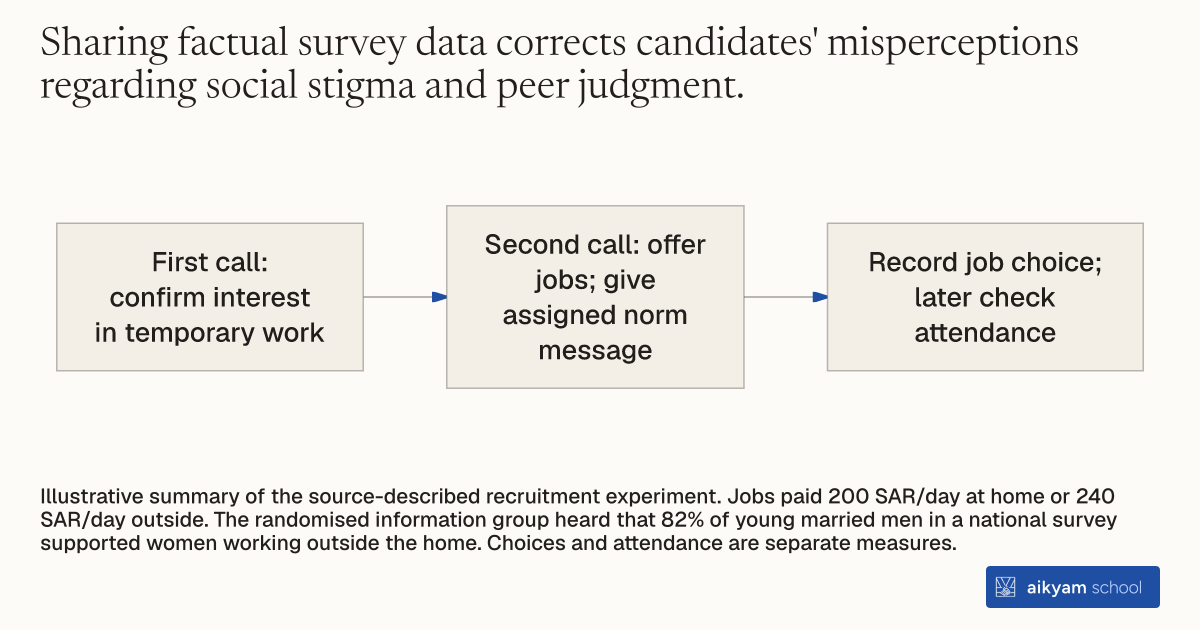
- First call: confirm interest in temporary work
- Second call: offer jobs; give assigned norm message
- Record job choice; later check attendance
Illustrative summary of the source-described recruitment experiment. Jobs paid 200 SAR/day at home or 240 SAR/day outside. The randomised information group heard that 82% of young married men in a national survey supported women working outside the home. Choices and attendance are separate measures.
See source →How
When to use
Female job seekers often hesitate to accept outside-the-home positions due to expected social backlash or misperceived societal disapproval. Employers face distorted labor supply when potential female workers assume public employment is widely stigmatized. Sharing empirical survey evidence of broad male support directly in recruitment offers encourages female candidates to choose higher-paying external jobs.
Incorporate survey findings about peer social norm support into job recruitment scripts to increase female applicant sign-up and attendance for outside-the-home positions.
- Recruiter calls potential female candidates to confirm interest in temporary work opportunities.
- Recruiter calls interested candidates a second time to offer a choice between a lower-paying home position and a higher-paying outside-the-home position.
- Recruiter reads a standardized statement to a randomized treatment group revealing that 82% of young married men in a national survey support female employment outside the home.
- Recruiter records each candidate's job selection during the phone call.
- Employer collects administrative attendance data to track whether candidates show up to work at the outside location.
Why it works
Realizing that the vast majority of men support female employment reduces social image concerns, motivating women to accept higher-paying jobs outside the home.
Example
A survey company in Saudi Arabia contacted 291 women interested in temporary enumerator work across Jeddah, Riyadh, and Dammam. When randomly informed that 82% of young married Saudi men support women working outside the home, the share of women choosing the outside-the-home job (paying 240 SAR/day) over the work-from-home job (paying 200 SAR/day) increased from 18% to 33%, and show-up rates increased from 15% to 27%.
About the study
Participants
291 women aged 18 to 45 across Jeddah, Riyadh, and Dammam, Saudi Arabia.
Study Design
Randomized field experiment embedded in a survey company recruitment drive, comparing job selection and attendance between a control group and a treatment group receiving national norm data.
Results
Informing women about peer support increased job choice for the outside-the-home position by 15 percentage points (from 18% to 33%) and increased job attendance by 11 percentage points (from 15% to 27%).