Try, learn and adjust
Check vehicle retirement and replacement records
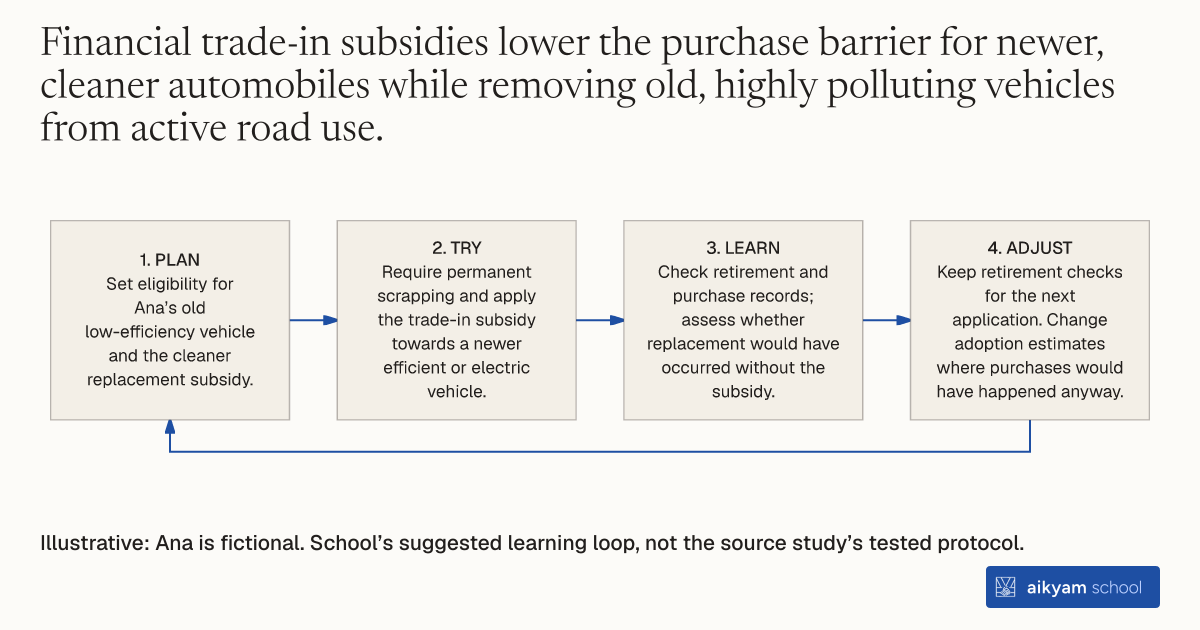
- Plan: Set eligibility for Ana’s old low-efficiency vehicle and the cleaner replacement subsidy.
- Try: Require permanent scrapping and apply the trade-in subsidy towards a newer efficient or electric vehicle.
- Learn: Check retirement and purchase records; assess whether replacement would have occurred without the subsidy.
- Adjust: Keep retirement checks for the next application. Change adoption estimates where purchases would have happened anyway.
Illustrative: Ana is fictional. School’s suggested learning loop, not the source study’s tested protocol.
See source →School’s suggested learning loop: observe permanent scrapping, replacement purchases and purchases attributable to the subsidy; do not count every subsidised sale as an added sale.
How
When to use
Older, inefficient passenger vehicles contribute disproportionately to on-road greenhouse gas emissions and local air pollution. Vehicle owners often delay retiring older automobiles due to replacement purchasing costs. Financial trade-in subsidies encourage vehicle owners to scrap aging automobiles and purchase newer, fuel-efficient models.
Incentivize vehicle owners to scrap old, low-efficiency automobiles in exchange for financial trade-in subsidies toward cleaner vehicle purchases.
- Establish eligibility criteria defining qualifying low-efficiency target vehicles for retirement.
- Provide financial trade-in vouchers or rebates to participating vehicle owners upon retiring eligible automobiles.
- Require participating vehicle owners to scrap older vehicles permanently to ensure complete fleet removal.
- Apply financial trade-in subsidies toward the purchase of newer, higher-efficiency fuel or electric vehicles.
- Track program participation and evaluate net adoption additionality to account for baseline vehicle replacement choices.
Why it works
Retiring aging vehicles immediately eliminates their ongoing tailpipe emissions.
Example
Trade-in programs in Texas and California provided financial support to car buyers, including targeted assistance for low- and middle-income households replacing older vehicles. Program evaluations found that trade-in subsidies increased purchases of fuel-efficient vehicles, though many participating buyers would have bought cleaner vehicles even without public subsidies.
About the study
Participants
Automobile owners across Texas, California, and nationwide in the United States, including targeted low- and middle-income household vehicle replacement programs.
Study Design
Regression discontinuity and difference-in-differences designs measuring vehicle sales, scrap rates, and post-purchase vehicle efficiency.
Results
Trade-in subsidies successfully increased purchases of fuel-efficient vehicles without causing fuel consumption rebound effects. However, many participating households would have purchased cleaner vehicles regardless of the program, demonstrating non-additionality and lowering cost-effectiveness.