Research steps
Ask about perceived HIV risk
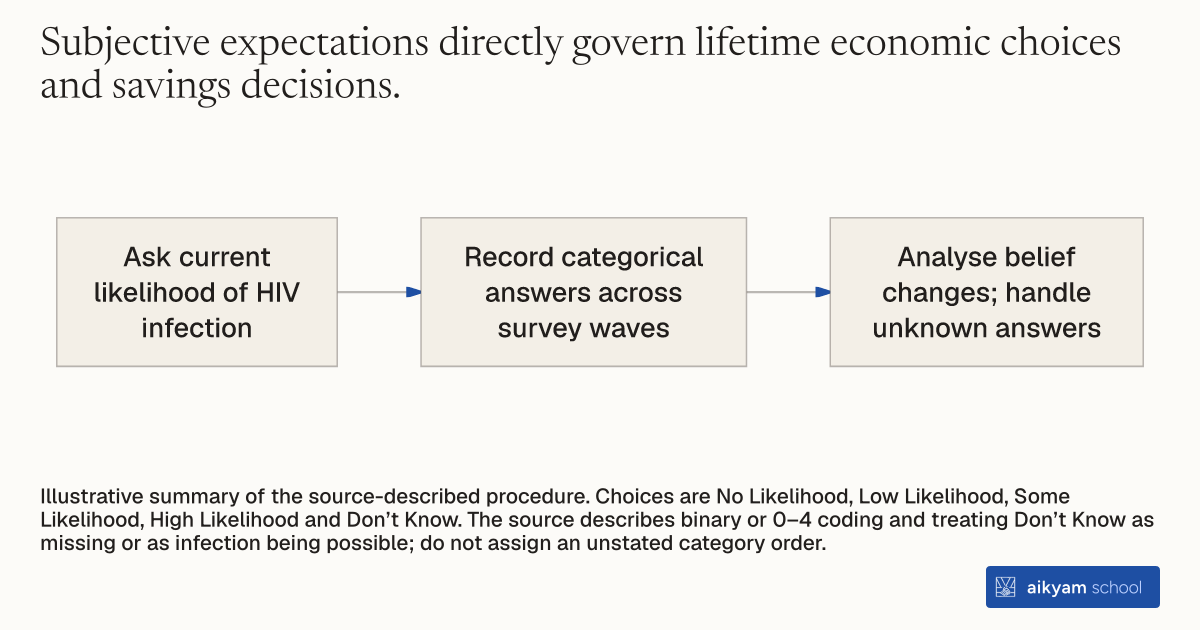
- Ask current likelihood of HIV infection
- Record categorical answers across survey waves
- Analyse belief changes; handle unknown answers
Illustrative summary of the source-described procedure. Choices are No Likelihood, Low Likelihood, Some Likelihood, High Likelihood and Don’t Know. The source describes binary or 0–4 coding and treating Don’t Know as missing or as infection being possible; do not assign an unstated category order.
See source →How
When to use
Measuring individual subjective health expectations in rural populations is difficult when respondents have varying levels of formal education. Direct categorical questions allow researchers to capture perceived disease risk without relying on complex numeric probabilities. Subjective belief measurement helps evaluate how health diagnostic interventions alter individual expectations over time.
Elicit subjective likelihood of disease infection using structured categorical response scales during household survey interviews.
- Survey enumerators ask respondents a direct question about their current perceived likelihood of HIV infection.
- Enumerators offer discrete choices including "No Likelihood", "Low Likelihood", "Some Likelihood", "High Likelihood", or "Don't Know".
- Enumerators record responses as binary indicators or code them on an ordinal scale from zero to four.
- Survey teams repeat belief elicitation across short-term and multi-year follow-up survey waves.
- Econometricians analyze belief updates by treating "Don't Know" responses as missing or imputing them as believing infection is possible.
Why it works
Structured categorical choices allow respondents to express risk perceptions clearly without needing numerical probability skills.
Example
Enumerators interviewed 1,813 rural Malawians across baseline and follow-up survey waves to track subjective HIV risk beliefs before and after diagnostic testing. At baseline, 59 percent of HIV-negative participants reported no likelihood of infection compared to 37 percent of HIV-positive participants.
About the study
Participants
1,813 rural Malawian adults (1,734 HIV-negative and 79 HIV-positive) interviewed at baseline in 2004 and re-interviewed in 2005 and 2006.
Study Design
Panel survey eliciting subjective infection beliefs across baseline, 2-to-6-month, and 2-year follow-up rounds, evaluated using linear instrumental variables and IV ordered probit models.
Results
Learning HIV-negative results increased the probability of reporting no likelihood of infection by 29.6 percentage points after 2 to 6 months (p < 0.01), but this effect dissipated to -9.1 percentage points after two years.