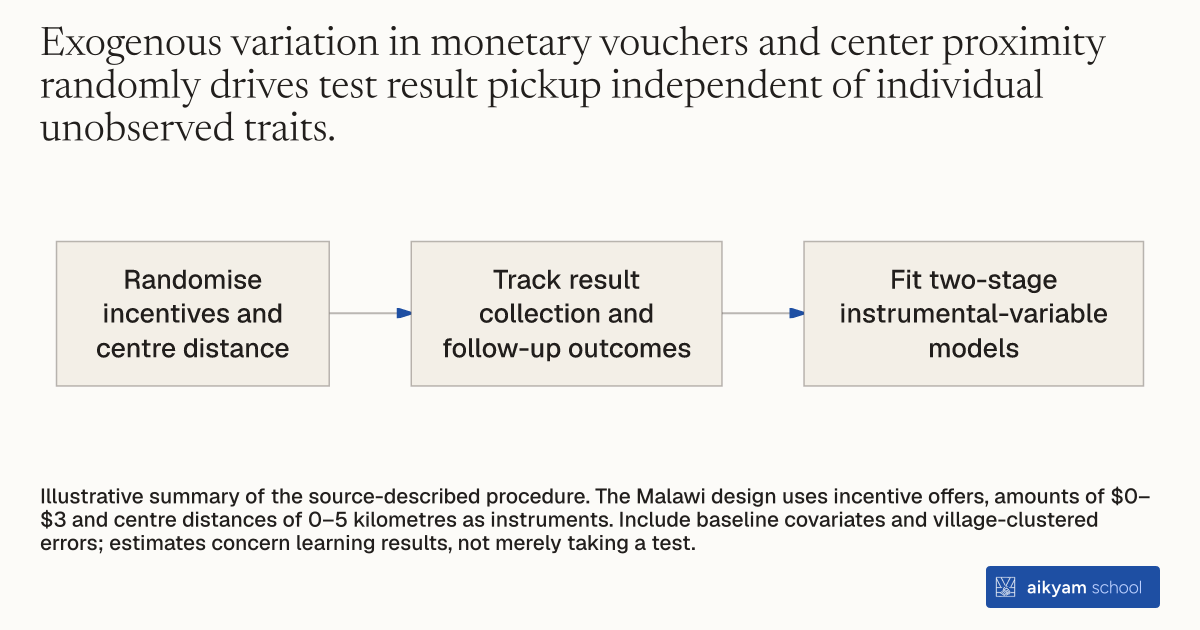
Research steps
Estimate effects of learning HIV results
- Randomise incentives and centre distance
- Track result collection and follow-up outcomes
- Fit two-stage instrumental-variable models
Illustrative summary of the source-described procedure. The Malawi design uses incentive offers, amounts of $0–$3 and centre distances of 0–5 kilometres as instruments. Include baseline covariates and village-clustered errors; estimates concern learning results, not merely taking a test.
See source →How
When to use
In observational studies, individuals endogenously choose whether to learn their health test results, creating selection bias when evaluating subsequent behaviors. Comparing people who know their health status with those who do not overstates or understates true causal effects because wealthier or more future-oriented individuals seek testing at different rates. Using randomized monetary incentives and distance costs as instrumental variables isolates the unbiased causal effect of learning diagnostic health results.
Estimate the causal impact of learning diagnostic health test results on beliefs and economic behavior using randomized incentive and distance instruments.
- Assign random monetary incentives and temporary center distances to tested individuals at baseline.
- Record baseline demographic covariates, including age, gender, education, marital status, and household expenditures.
- Track whether individuals attend health centers to pick up their diagnostic test results.
- Estimate first-stage regressions using randomized incentive offer, incentive amount, and distance to predict test result pickup.
- Re-interview respondents in follow-up survey waves to collect subjective health beliefs, labor supply, savings, and expenditures.
- Estimate two-stage linear instrumental variable models to calculate unbiased local average treatment effects of learning test results on follow-up outcomes.
Why it works
This experimental variation creates valid comparison groups and eliminates selection bias in outcome regressions.
Example
Researchers in rural Malawi used randomly assigned monetary vouchers worth zero to three dollars and counseling center distances ranging from zero to five kilometers as instruments for learning HIV results among 1,813 tested adults. Two-stage least squares estimation showed that learning HIV-negative status increased daily wage work by 0.64 hours two years later, but caused no significant change in savings or total annual income.
About the study
Participants
1,813 rural Malawian adults across 125 villages with complete baseline and 2006 follow-up survey data (41 percent male, average age 35 years, 4.9 years of education).
Study Design
Two-stage linear instrumental variables regression (2SLS) instrumenting test result collection with randomized incentive offers, incentive amounts, and center distances, controlling for baseline demographic covariates and village-clustered standard errors.
Results
First-stage instruments predicted result pickup with an F-statistic of 128.11 for HIV-negatives and 8.6 for HIV-positives; instrumental variable estimates revealed no statistically significant 2-year impacts on probability of having savings (coefficient 0.021, SE 0.049) or log income (coefficient 0.109, SE 0.194) among HIV-negative individuals.