Research steps
Compare immigrant earnings
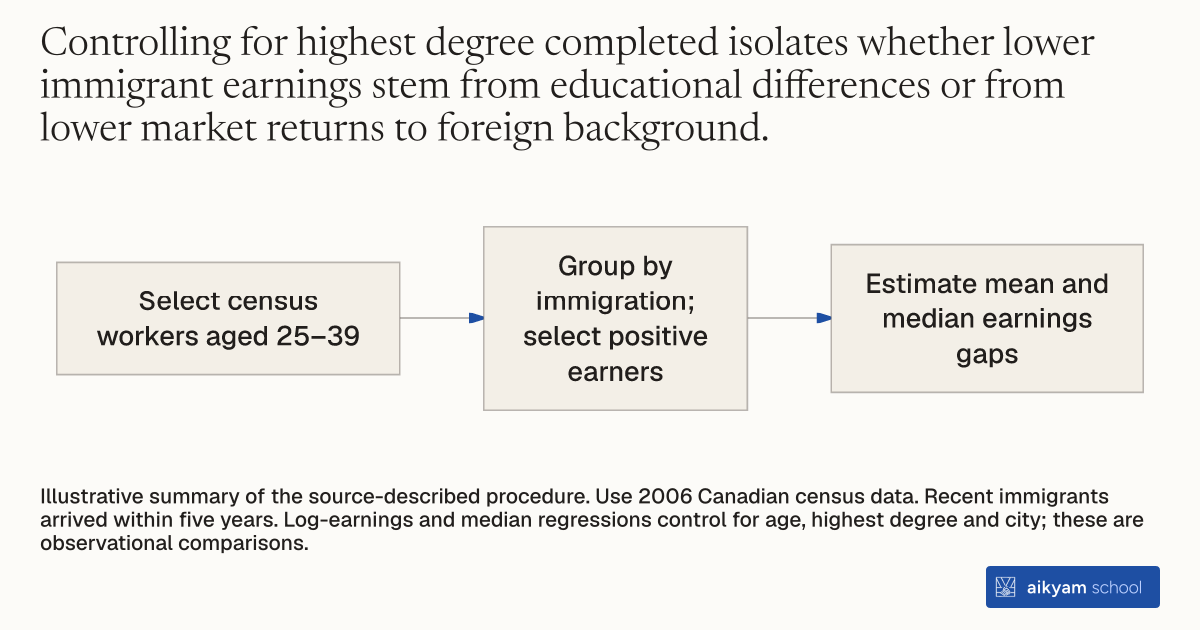
- Select census workers aged 25–39
- Group by immigration; select positive earners
- Estimate mean and median earnings gaps
Illustrative summary of the source-described procedure. Use 2006 Canadian census data. Recent immigrants arrived within five years. Log-earnings and median regressions control for age, highest degree and city; these are observational comparisons.
See source →How
When to use
Labor market analysts need to estimate the earnings gap between recent immigrants and native workers while controlling for background differences. Raw income comparisons miss the fact that skilled immigrants often hold higher education levels than non-immigrants. This method measures conditional wage gaps by regressing employment status and earnings on immigrant arrival status alongside demographic fixed effects.
Estimate immigrant wage gaps by running linear and quantile regressions on census microdata while controlling for education, age, and location.
- Extract individual-level microdata from the national public-use census file for workers aged twenty-five to thirty-nine in the labor force.
- Group respondents into non-immigrants and recent immigrants who arrived within the last five years.
- Restrict the earnings sample to individuals reporting positive labor income in Canadian dollars.
- Estimate an ordinary least squares regression of log earnings on immigrant status, adding fixed effects for age, highest degree completed, and city of residence.
- Apply quantile regression around the median to measure conditional median earnings gaps relative to non-immigrant baseline values.
Why it works
Quantile regressions prevent extreme income outliers from distorting typical earnings differences between native and immigrant workers.
Example
Philip Oreopoulos analyzed 127,149 individuals from the 2006 Canadian Census microdata, finding that recent immigrants earned median wages of $21,000 compared to $33,000 for native workers. Controlling for age, highest degree, and city increased the relative median wage gap from 36 percent lower earnings to 48 percent lower earnings for recent immigrants.
About the study
Participants
N = 127,149 individuals aged 25-39 from the 2006 Public-Use Canadian Census microdata, with 119,275 positive earners in the labor force in Canada.
Study Design
Cross-sectional observational study using ordinary least squares regressions for log mean earnings and quantile regressions for median earnings, conditional on age, highest degree completed, and city of residence fixed effects.
Results
Recent immigrants experienced an unemployment rate of 10.4 percent compared to 5.9 percent for non-immigrants, and median earnings of $21,000 compared to $33,000 for non-immigrants. Conditioning on age, highest degree, and city increased the estimated median earnings ratio from 1.57 (36 percent lower) to 1.94 (48 percent lower).