Research procedure
Track erased chalk tax codes
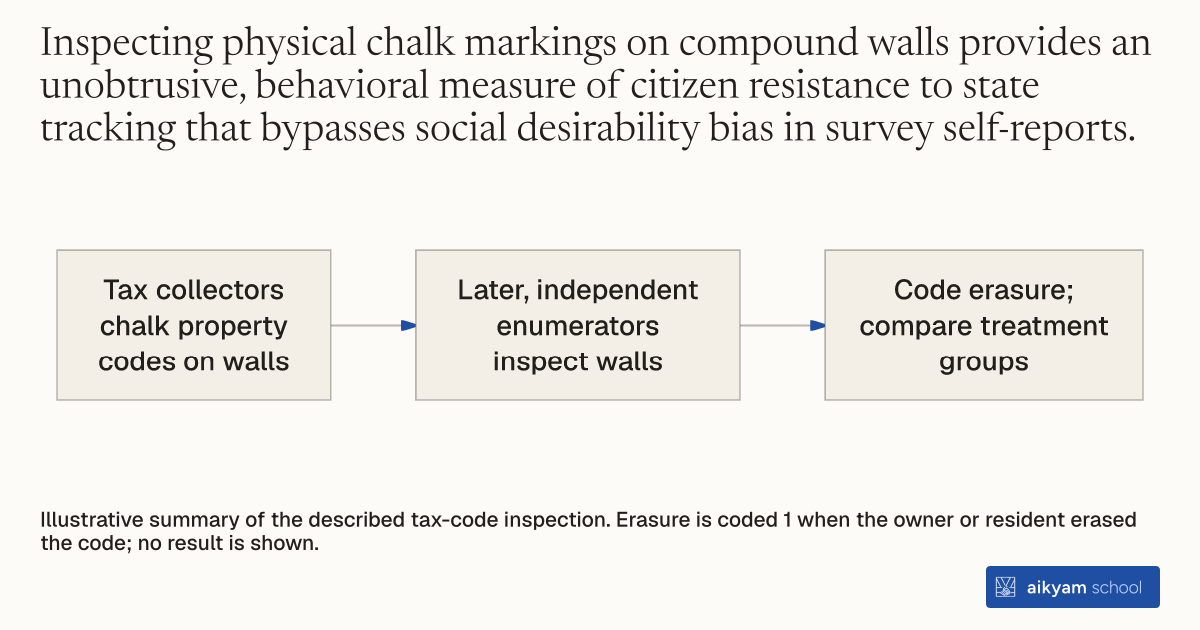
- Tax collectors chalk property codes on walls
- Later, independent enumerators inspect walls
- Code erasure; compare treatment groups
Illustrative summary of the described tax-code inspection. Erasure is coded 1 when the owner or resident erased the code; no result is shown.
See source →How
When to use
In low-capacity states where local tax collectors write unique identification codes on property walls in chalk, tracking whether citizens preserve or erase these markings offers a direct behavioral metric of citizen willingness to remain visible to state tax authorities. Researchers and revenue agencies face difficulties measuring subtle resistance or compliance with state legibility efforts using self-reported survey questions alone. Program evaluators inspect compound walls after property tax campaigns to record whether chalked tax codes have been intentionally scrubbed or maintained by property owners.
Track citizen compliance with state legibility initiatives by auditing whether property owners erase chalk-written tax codes from compound walls.
- Deploy official tax collectors to write standardized property tax identification codes in chalk on compound exterior walls during municipal tax collection campaigns as described in SI Section D.1.
- Allow time to pass following the tax collection campaign before conducting field inspection audits.
- Send independent enumerators to inspect the compound exterior walls of surveyed property owners.
- Record an indicator equal to 1 if the property owner or resident erased the chalked tax code from the wall.
- Analyze erasure rates across experimental treatment arms to evaluate whether interventions alter citizen willingness to remain legible to state tax collectors.
Example
Enumerators in Kananga, DRC, audited compound exterior walls to record whether residents erased chalk tax codes written during a tax collection campaign, finding that land titling treatment reduced code erasure by 7.5 percentage points.
About the study
Participants
4,343 randomly sampled households across 364 neighborhoods in Kananga, Democratic Republic of Congo, with 483 eligible households in the main analysis sample.
Study Design
Randomized controlled trial evaluating the impact of a subsidized land titling program on unobtrusive behavioral tax compliance and state legibility tracking.
Results
Program assignment caused a 7.5 percentage point reduction in the probability that households erased chalk tax codes written on compound walls during tax collection campaigns.