Research steps
Verify vaccinations from health records
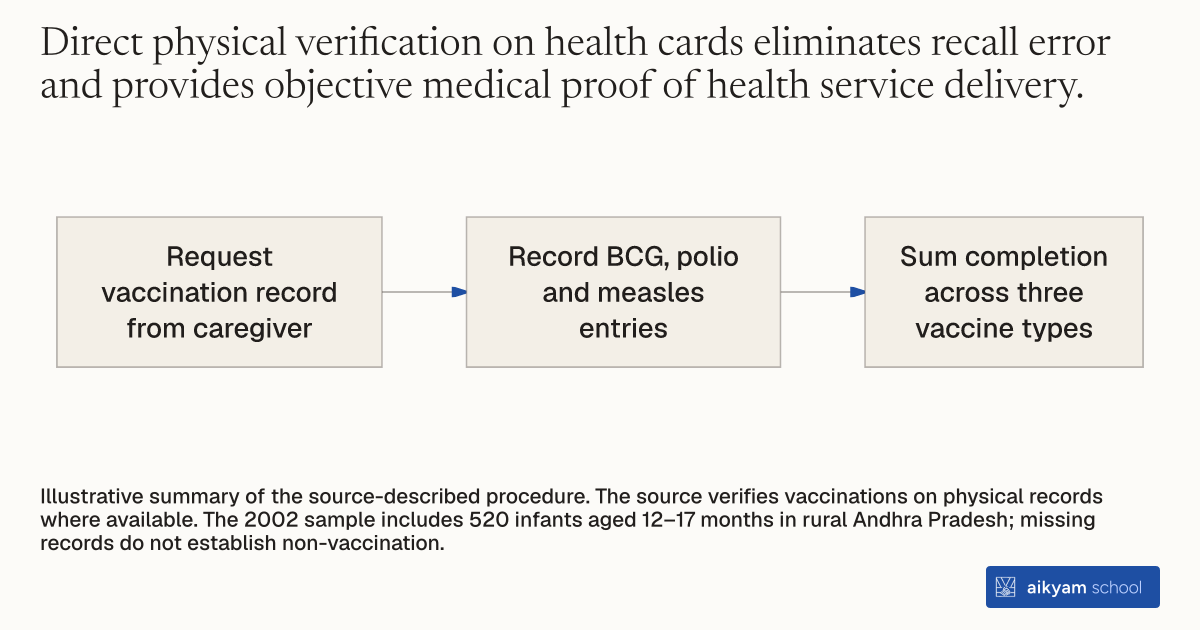
- Request vaccination record from caregiver
- Record BCG, polio and measles entries
- Sum completion across three vaccine types
Illustrative summary of the source-described procedure. The source verifies vaccinations on physical records where available. The 2002 sample includes 520 infants aged 12–17 months in rural Andhra Pradesh; missing records do not establish non-vaccination.
See source →How
When to use
Infants in developing regions face high disease risks when early childhood health services fail to deliver core immunizations. Relying on maternal recall introduces reporting bias when evaluating health program coverage. Inspecting physical vaccination health cards directly verifies whether children received essential early life immunizations against major childhood diseases.
Verify infant health coverage by inspecting physical immunization cards to record received doses of core childhood vaccines.
- Request the child's official physical health or vaccination card from the primary caregiver during household survey visits.
- Examine health card entries to record receipt of the BCG vaccine protecting against tuberculosis.
- Record all documented doses of the oral polio vaccine received by the child.
- Verify documented completion of the measles vaccination on the health card.
- Sum the total number of verified major vaccinations received out of 3 core vaccine types to measure individual immunization completeness.
Why it works
Early protection against infectious diseases reduces infant morbidity and prevents early growth faltering.
Example
In 2002 in rural Andhra Pradesh, survey enumerators checked vaccination cards for 520 infants aged 12 to 17 months. Children born in village councils with female leaders reserved in 1995 received 0.182 more major vaccinations out of 3, including an 8.6 percentage point increase in measles vaccination and a 6.3 percentage point increase in polio vaccination compared to unreserved councils.
About the study
Participants
520 rural children aged 12 to 17 months surveyed in late 2002 across 20 mandals in 6 rural districts of Andhra Pradesh, India.
Study Design
Cross-sectional health verification study using physical vaccination cards during Round 1 of the Young Lives Survey, estimating intent-to-treat models with mandal fixed effects.
Results
Early exposure to female political reservation increased the total number of major completed vaccinations by 0.182 vaccines out of 3, increasing measles vaccination probability by 8.6 percentage points and polio vaccination probability by 6.3 percentage points.