Research steps
Measure height for age
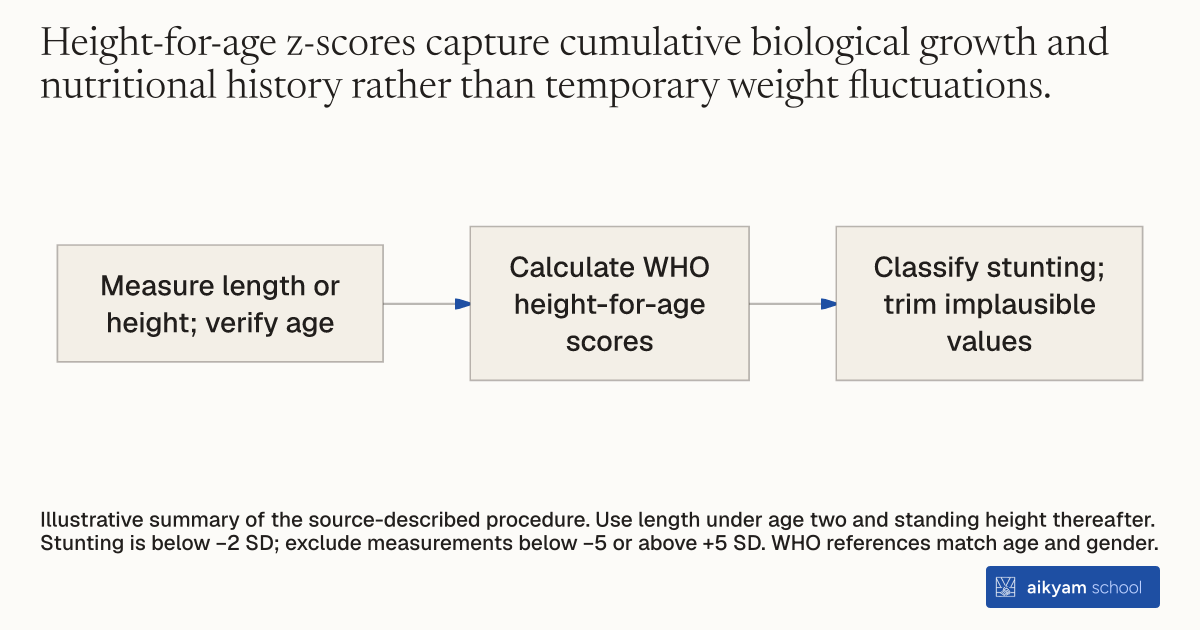
- Measure length or height; verify age
- Calculate WHO height-for-age scores
- Classify stunting; trim implausible values
Illustrative summary of the source-described procedure. Use length under age two and standing height thereafter. Stunting is below −2 SD; exclude measurements below −5 or above +5 SD. WHO references match age and gender.
See source →How
When to use
Early childhood malnutrition and growth faltering cause severe, irreversible deficits in physical growth and long-term cognitive potential. Systematically measuring child height and calculating standardized height-for-age z-scores provides an objective, biological indicator of chronic nutritional status and stunting. This method enables researchers and health programs to track physical growth improvements and evaluate early life health interventions.
Measure child standing height or recumbent length and convert raw measurements into standardized height-for-age z-scores relative to WHO growth references.
- Measure the recumbent length of infants under two years or standing height of older children using standardized field stadiometers.
- Record child exact age in months using verified birth certificates or local official health records.
- Calculate individual height-for-age z-scores by comparing measured height against age-and-gender-matched international WHO reference population medians.
- Classify children with height-for-age z-scores below -2 standard deviations from the international reference median as stunted.
- Trim implausible outlier measurements below -5 standard deviations or above +5 standard deviations to maintain clean data quality.
Why it works
Tracking z-scores and stunting status over longitudinal rounds directly tests whether early childhood investments produce sustained physical growth gains.
Example
In rural Andhra Pradesh, survey teams measured height for 501 eight-year-old children in 2009. Children born in village councils reserved for female leaders in 1995 maintained a height-for-age z-score 0.258 standard deviations higher than children exposed to female leadership only after age 5, alongside a 12 percentage point reduction in stunting at age 5 to 6.
About the study
Participants
1,547 rural children aged 6 to 17 months measured across 2002, 2007, and 2009 survey rounds in 20 mandals across 6 rural districts of Andhra Pradesh, India (501 children in the main 12 to 17 month cohort tracked to 2009).
Study Design
Longitudinal anthropometric survey tracking height-for-age z-scores and stunting rates across three waves, trimming measurements beyond +/- 5 SD and controlling for monthly age fixed effects.
Results
In 2009 at age 8, early exposure to female reservation increased height-for-age z-scores by 0.258 SD (baseline mean -1.602); in 2007 at age 5 to 6, it reduced stunting probability by 12.7 percentage points (baseline mean 42.3%); and in 2002 at 12 to 17 months, it reduced stunting by 11.8 percentage points (baseline mean 40.0%).