Research steps
Model voucher-funded spring access
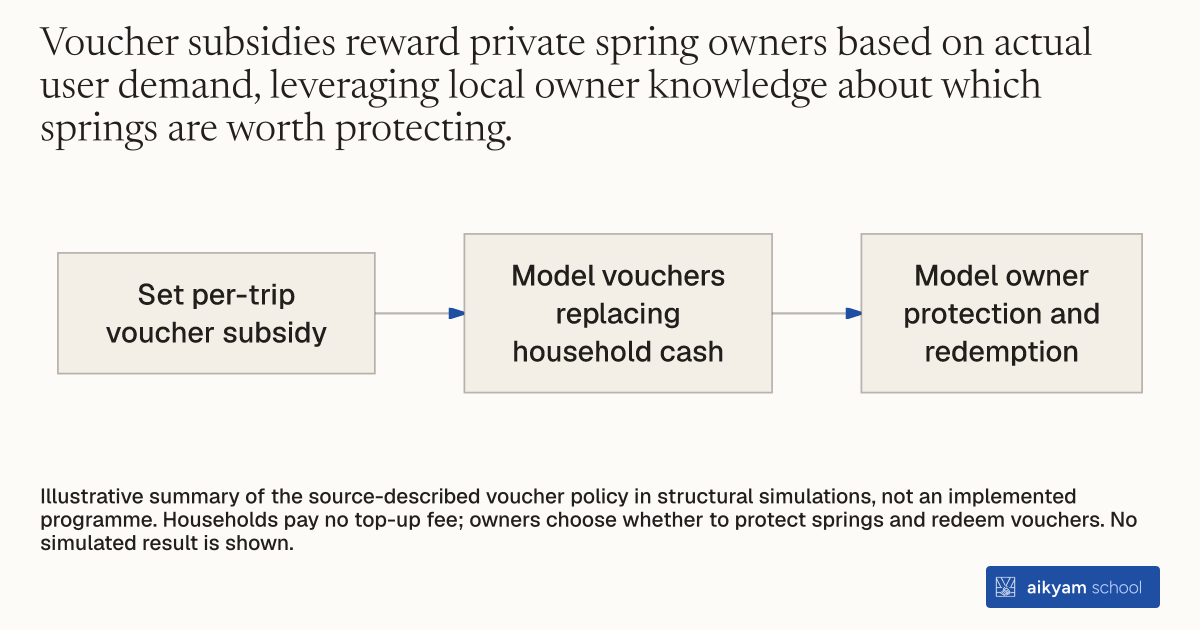
- Set per-trip voucher subsidy
- Model vouchers replacing household cash
- Model owner protection and redemption
Illustrative summary of the source-described voucher policy in structural simulations, not an implemented programme. Households pay no top-up fee; owners choose whether to protect springs and redeem vouchers. No simulated result is shown.
See source →How
When to use
Private water infrastructure investment is under-provided because landowners cannot capture full consumer surplus without setting distorted prices. Public planners need a mechanism to incentivize private infrastructure protection while keeping water free for rural households.
Implement a public water voucher subsidy mechanism to incentivize private infrastructure investment while preserving free household access.
- Policy makers establish a fixed voucher subsidy payment per water collection trip redeemed by spring owners.
- Policy makers distribute water vouchers directly to eligible rural households.
- Policy makers prohibit participating private spring owners from charging top-up user fees to households.
- Households collect water from protected springs and give vouchers to spring owners instead of cash.
- Spring owners choose whether to protect springs and redeem collected vouchers for government payments.
Why it works
Restricting top-up pricing prevents price distortions, ensuring households continue collecting clean water without resorting to dirtier free sources.
Example
In structural simulations across 184 spring communities in western Kenya, a government voucher subsidy of 0.0012 US dollars per trip induced profit-maximizing private owners to protect 11 percent of springs, generating 124 US dollars in net welfare gains per spring after accounting for a 30 percent tax deadweight loss.
About the study
Participants
Counterfactual simulations across 184 viable spring communities serving rural households in Busia and Butere-Mumias districts, Kenya.
Study Design
Backward-induction equilibrium simulation modeling household discrete choice demand, private profit maximization, and uniform voucher pricing with a 30 percent deadweight loss of taxation.
Results
A neoclassical policy maker sets a voucher price of 0.0012 US dollars per trip, prompting 11% of spring owners to protect springs and achieving 124 US dollars in net welfare gains per spring; a paternalistic policy maker sets a price of 0.0032 US dollars per trip, inducing 46% protection.