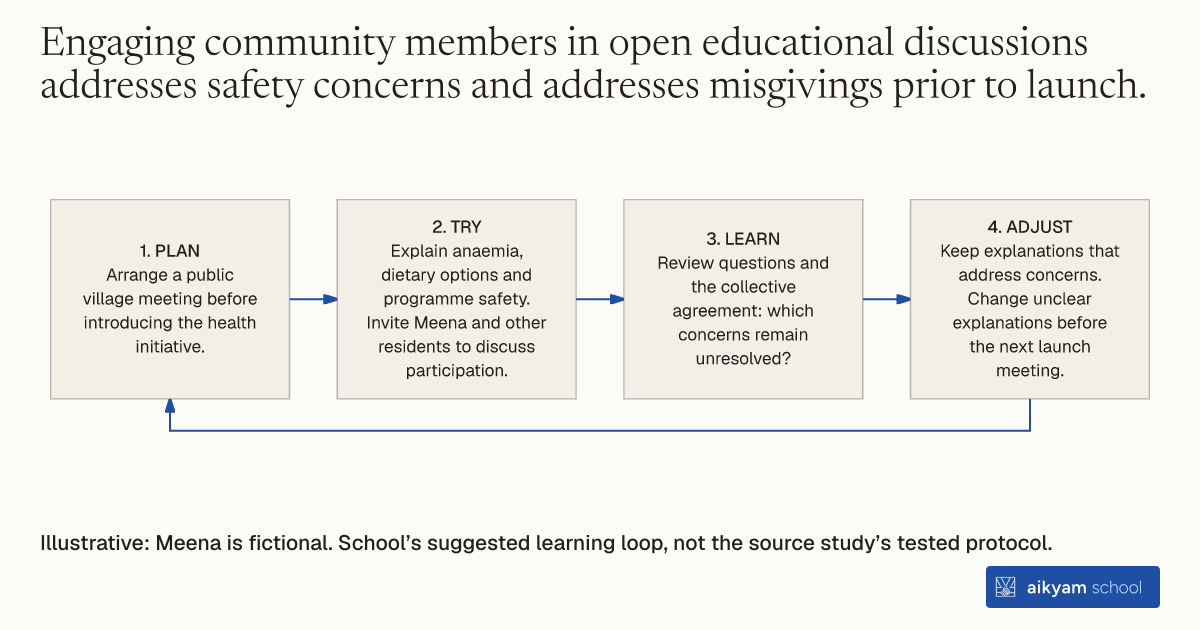
Try, learn and adjust
Check community questions before programme launch
- Plan: Arrange a public village meeting before introducing the health initiative.
- Try: Explain anaemia, dietary options and programme safety. Invite Meena and other residents to discuss participation.
- Learn: Review questions and the collective agreement: which concerns remain unresolved?
- Adjust: Keep explanations that address concerns. Change unclear explanations before the next launch meeting.
Illustrative: Meena is fictional. School’s suggested learning loop, not the source study’s tested protocol.
See source →School’s suggested, untested loop. Observe questions and collective agreement; agreement does not establish health effects.
How
When to use
When launching community-wide health interventions, individual adoption can fail if residents do not understand or trust the program. Unilateral introductions of new food fortification technologies can generate local skepticism or resistance. Holding village-wide consensus meetings engages community members, builds collective agreement, and secures buy-in before launching new health initiatives.
Host inclusive community meetings across targeted villages to explain health issues and secure collective community approval before launching local interventions.
- Schedule a public village meeting in a central community location prior to introducing the new health initiative.
- Present educational information detailing the causes and consequences of micronutrient deficiencies such as iron deficiency anemia.
- Discuss non-program dietary adjustments that households can adopt to prevent nutritional deficiencies.
- Explain the mechanics, operations, and safety measures of the proposed community intervention.
- Invite community questions and facilitate open discussion to build local trust.
- Seek formal collective agreement from attending residents to participate in the village-wide program.
Why it works
Securing collective public agreement creates social endorsement, making individual households more willing to participate in community health initiatives.
Example
NGO Seva Mandir held community consensus meetings across 65 treatment villages in Udaipur district, Rajasthan, before introducing a flour fortification program. All 65 treatment villages collectively agreed to participate in the fortification program.
About the study
Participants
Households across 134 villages (65 treatment villages and 69 control villages) in Udaipur district, Rajasthan.
Study Design
Cluster randomized evaluation where community consensus meetings were held in all study villages before launching a 3-year local chakki flour fortification program.
Results
All 65 treatment villages agreed to participate during the meetings, but the program ultimately yielded no statistically significant impact on hemoglobin concentration (-0.031 g/dL for adult females, +0.129 g/dL for adult males) or anemia status (+0.016 for females, -0.039 for males).