In Simple Words
Think of repairing a broken bicycle: fixing the flat tire gets the bike rolling, but teaching the rider how to navigate rocky roads keeps them moving forward without breaking down again once the mechanic leaves.
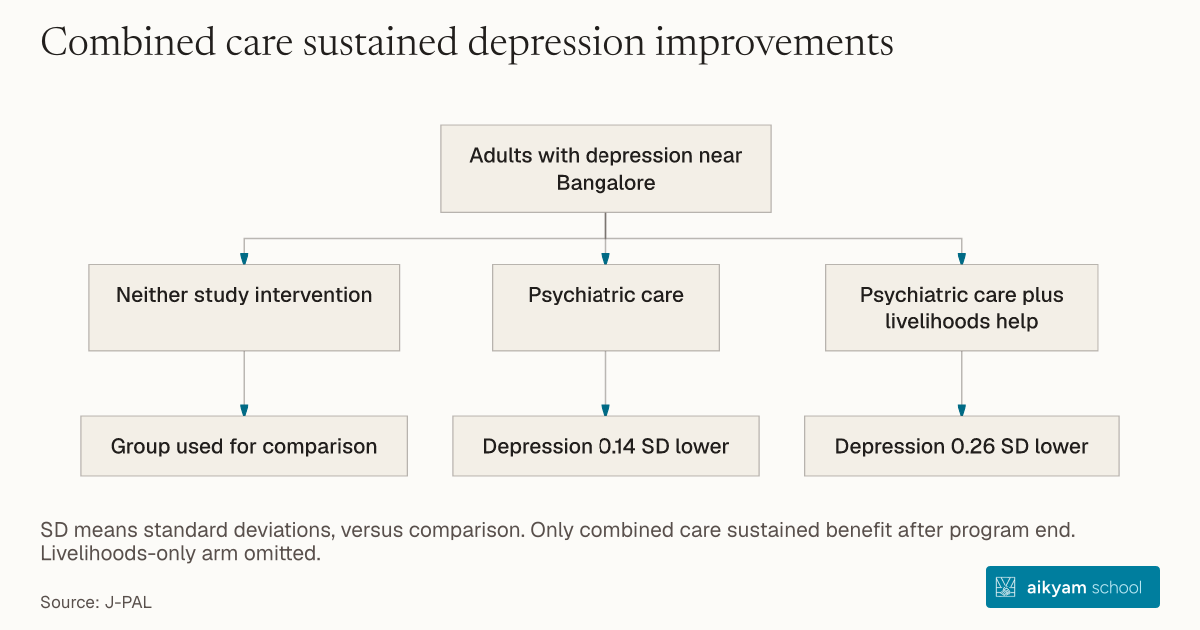
Adults with depression near Bangalore
- Neither study intervention
- Group used for comparison
- Psychiatric care
- Depression 0.14 SD lower
- Psychiatric care plus livelihoods help
- Depression 0.26 SD lower
The source reports symptom reductions of 0.14 standard deviations with psychiatric care and 0.26 with combined care, each relative to comparison. Only combined care sustained improvements after the program. Reported effects versus comparison. Only combined care sustained benefit after the program. Livelihoods-only arm omitted.
See source →Research question
Single-channel medical interventions often fail to sustain long-term mental health improvements after active clinical treatment concludes. Combining clinical treatment with vocational support addresses both psychological symptoms and economic capability simultaneously.
Participants
N = 1,000 adults with symptoms of mild or moderate depression (86 percent women) across 506 peri-urban villages near Bangalore, India.
Study Design
Randomized controlled trial evaluating bundled Psychiatric Care and Livelihoods Assistance (PC/LA, N = 195) against standalone Psychiatric Care (PC, N = 207), standalone Livelihoods Assistance (LA, N = 205), and control (N = 395) across a 26-month evaluation timeline.
Results
Combined PC/LA reduced depression symptoms by 0.26 standard deviations and sustained improvements post-program, proving 3.5 times more effective while costing only 5 percent more than standalone PC (US$232 versus US$221 per individual).
Takeaway
Package clinical psychiatric care with group work-challenge meetings and one-on-one job placement support to achieve cost-effective, persistent mental health gains.
Source and citation
See source →Read alongside the research
Plain-English glossary
Original explanations, informed by the references below. Examples are illustrations, not data from the studies above. The research text stays unchanged.
- Randomized controlled trial
A study that uses chance, like drawing lots, to decide who receives each option being compared. Researchers compare the groups’ outcomes to estimate the effect of those options.
ExampleA lottery assigns volunteers to a training programme or a comparison group. Researchers then compare their outcomes.
GET-IT glossary · Randomized study ↗Read more about randomized controlled trial →