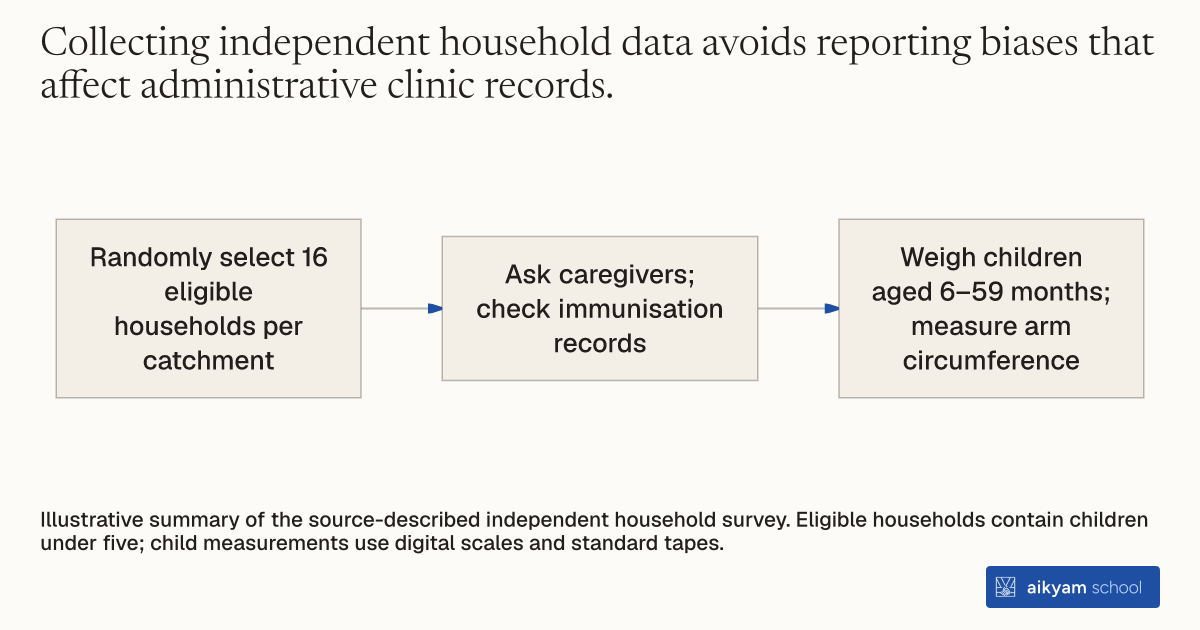
Research steps
Survey caregivers and measure children
- Randomly select 16 eligible households per catchment
- Ask caregivers; check immunisation records
- Weigh children aged 6–59 months; measure arm circumference
Illustrative summary of the source-described independent household survey. Eligible households contain children under five; child measurements use digital scales and standard tapes.
See source →How
When to use
Evaluating primary health interventions on child nutrition requires objective community measurement. Relying solely on administrative clinic records risks reporting bias and misses out-of-facility health changes. Conducting independent household surveys that combine self-reported health practices with child weight and mid-upper arm circumference measurements provides accurate health impact data for rural health programs.
Administer independent representative household surveys combining health practice questionnaires with child anthropometric measurements.
- Survey managers randomly select 16 households containing children under five in each rural community catchment area.
- Independent survey enumerators visit selected households and interview main child caregivers using standardized survey questionnaires.
- Enumerators record household health practices including breastfeeding status, stool disposal methods, and child deworming history.
- Enumerators inspect child health cards to verify completed age-specific immunization schedules.
- Enumerators weigh children aged 6 to 59 months using digital scales and measure mid-upper arm circumference using standard tapes.
Why it works
Combining behavioral survey questions with physical anthropometric measurements produces unbiased estimates of community health impact and child malnutrition.
Example
Survey teams interviewed 738 households across 47 rural health catchment areas in Zambia to evaluate Community Health Assistants. In control areas, 21.0 percent of children under five were underweight and 5.1 percent were severely underweight. In districts with health workers recruited through career advertisements, child underweight prevalence fell by 5.3 percentage points (a 25 percent reduction) and severe underweight prevalence fell by 2.8 percentage points (a 55 percent reduction).
About the study
Participants
738 households with children under five across 47 rural districts in Zambia (582 children aged 6 to 59 months measured for weight-for-age).
Study Design
Cross-sectional survey administered by independent enumerators comparing household health practices and child anthropometrics between treatment and control districts.
Results
Career treatment reduced moderate-to-severe child underweight prevalence by 5.3 percentage points (from 21.0 percent to 15.7 percent, p=0.058 RI) and severe underweight prevalence by 2.8 percentage points (from 5.1 percent to 2.3 percent, p=0.099 RI), yielding an overall standardized health effect of 0.108 (p=0.001).