Research procedure
Verify household survey measures
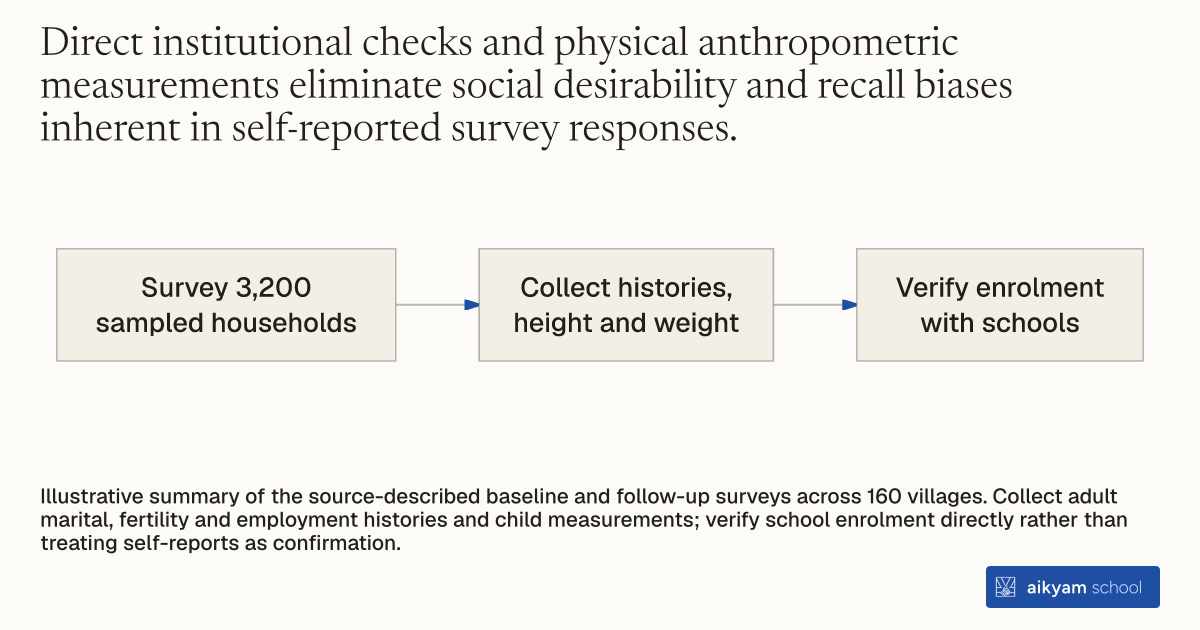
- Survey 3,200 sampled households
- Collect histories, height and weight
- Verify enrolment with schools
Illustrative summary of the source-described baseline and follow-up surveys across 160 villages. Collect adult marital, fertility and employment histories and child measurements; verify school enrolment directly rather than treating self-reports as confirmation.
See source →How
When to use
When evaluating community programs, self-reported survey data on education, employment, and health can suffer from reporting bias. This method collects verified household data using direct physical measurement and institutional cross-checks. It helps researchers measure baseline and endline outcomes accurately across rural households.
Collect verified household survey data and physical measurements from sample families before and after an intervention.
- Surveyors select a random sample of 3,200 households across 160 rural villages.
- Surveyors collect demographic and socioeconomic data for all family members including age, sex, and education.
- Surveyors record marital, fertility, and employment histories for adult family members.
- Surveyors measure the weight and height of children to record anthropometric data.
- Surveyors contact each child's school directly to verify self-reported school enrollment data.
Why it works
Comparing pre- and post-intervention survey rounds ensures clean baseline balance and precise impact tracking.
Example
In 160 rural villages across North India, surveyors administered pre- and post-intervention surveys to 3,200 households. Verified data showed a 5 percentage point increase in school enrollment and significant BMI gains for girls in treatment villages, while boys showed no change.
About the study
Participants
160 rural villages (80 treatment, 80 comparison) and 3,200 households across Haryana, Punjab, Rajasthan, and Uttar Pradesh, India.
Study Design
Pre- and post-intervention multi-module household survey with direct school enrollment verification and physical height and weight measurements.
Results
Girls aged 6 to 17 in treatment villages were 5 percentage points more likely to be enrolled in school, and girls gained significant BMI, closing 30 to 40 percent of the BMI gap relative to wealthy Delhi residents.