Research overview
Link electoral evidence
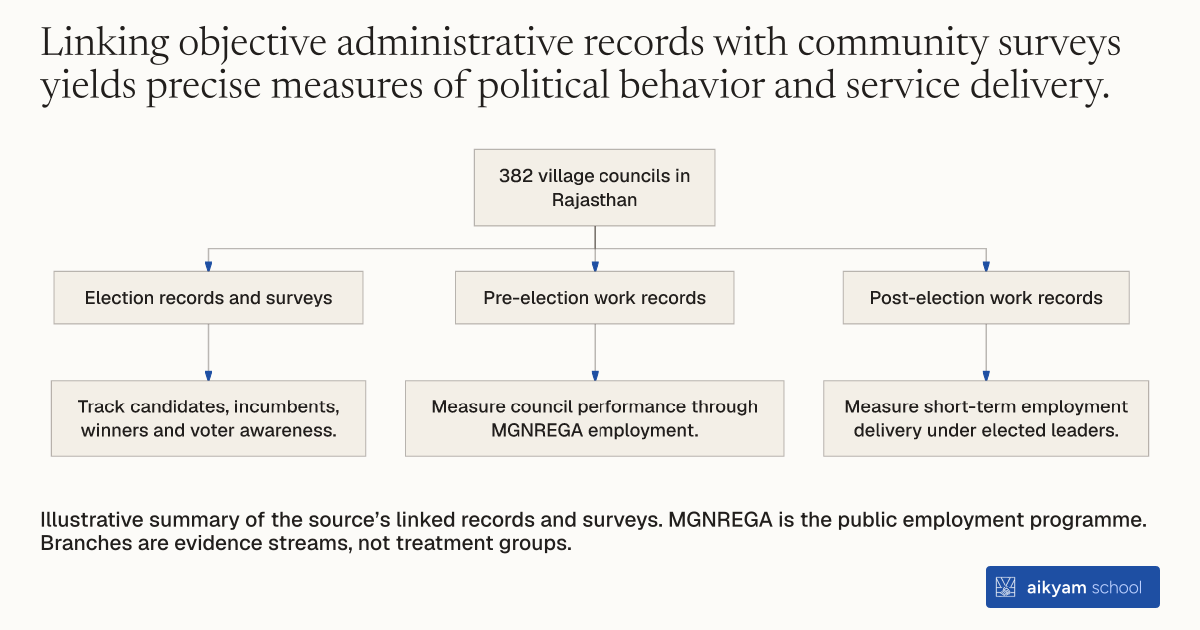
382 village councils in Rajasthan
- Election records and surveys
- Track candidates, incumbents, winners and voter awareness.
- Pre-election work records
- Measure council performance through MGNREGA employment.
- Post-election work records
- Measure short-term employment delivery under elected leaders.
Illustrative summary of the source’s linked records and surveys. MGNREGA is the public employment programme. Branches are evidence streams, not treatment groups.
See source →How
When to use
In local governance evaluations, relying on self-reported survey data alone can mismeasure political participation and post-election government performance. Researchers need objective metrics to track candidate entry, electoral outcomes, and real program delivery across local elections. This method combines government administrative records with household surveys to measure democratic accountability and governance quality.
Combine government administrative datasets and field surveys to measure election outcomes and government performance.
- Research staff gather administrative records from official state election databases to count candidate entry and track election winners.
- Field workers conduct household surveys across rural communities to assess voter awareness and candidate backgrounds.
- Analysts collect public MGNREGA program records to evaluate council leaders' pre-election job performance in creating employment.
- Survey teams track candidate characteristics to identify changes in leader demographics, such as lower caste or female entry.
- Evaluators analyze post-election administrative MGNREGA employment data to measure short-term government service delivery.
Why it works
Combining election outcomes with government program performance metrics isolates how voter information and candidate quotas affect democratic accountability.
Example
In Rajasthan, India, researchers evaluated voter campaigns and gender quotas across 382 village councils during the 2010 elections. By matching state administrative records on MGNREGA employment generation with candidate survey data, researchers discovered that low-performing incumbents were 22 percent less likely to run for office in campaign villages. Evaluators also tracked post-election MGNREGA employment output to identify short-term administrative adjustments among newly elected leaders.
About the study
Participants
382 village councils representing rural populations in Rajasthan, India.
Study Design
Randomized controlled trial collecting data from official government administrative sources and household surveys to evaluate candidate selection, reelection rates, and post-election program execution.
Results
Exposure to the campaign reduced reelection seeking by 22 percent among incumbents performing one standard deviation below mean performance. In previously reserved villages exposed to the campaign, high-performing candidates and family members saw a 26 percentage point increase in running from a 54 percent baseline. Post-election administrative data revealed lower short-term MGNREGA employment generation in non-reserved councils exposed to the general information campaign.