Research steps
Build farmer lists through local informants
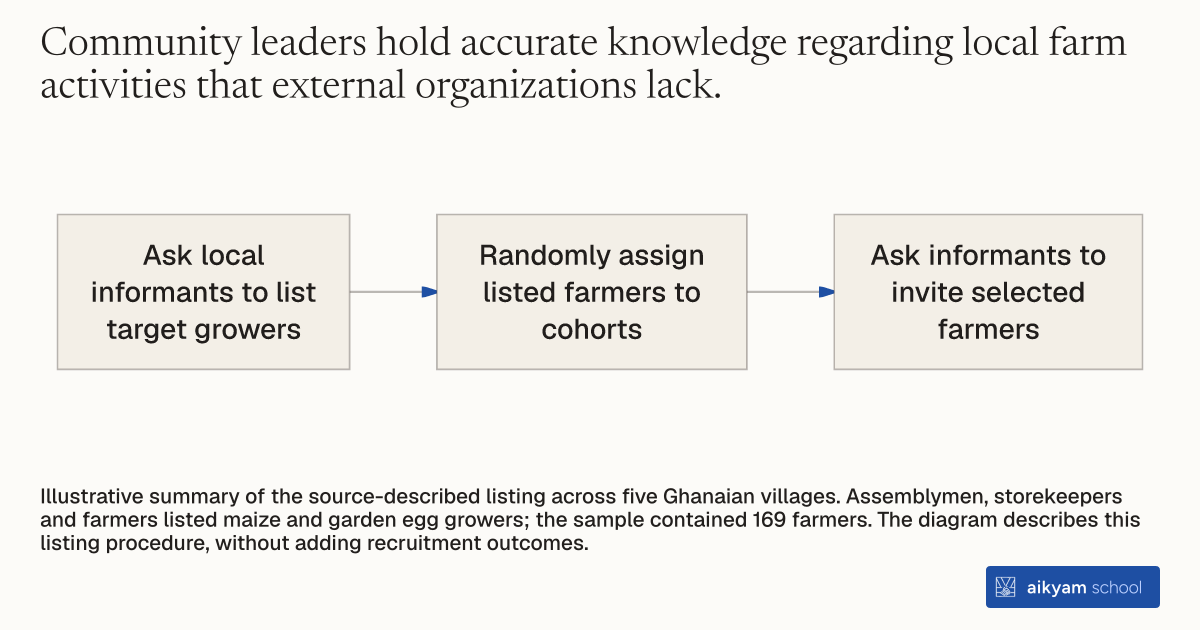
- Ask local informants to list target growers
- Randomly assign listed farmers to cohorts
- Ask informants to invite selected farmers
Illustrative summary of the source-described listing across five Ghanaian villages. Assemblymen, storekeepers and farmers listed maize and garden egg growers; the sample contained 169 farmers. The diagram describes this listing procedure, without adding recruitment outcomes.
See source →How
When to use
This method applies when an organization needs to identify and recruit smallholder farmers in rural areas without official registers. It solves the challenge of locating specific crop growers across dispersed communities for agricultural interventions. The approach helps program leaders build accurate community population lists through trusted local channels.
Identify and recruit target smallholder crop growers by using local community key informants to construct complete village listings.
- Identify key community figures, including district assemblymen, storekeepers, and established farmers in each targeted village.
- Contact these key informants to compile a complete list of all local farmers growing target crops.
- Randomly assign listed farmers into treatment and control cohorts for program delivery.
- Direct the same community informants to invite the selected farmers to group meetings.
Why it works
Working through trusted local figures also establishes initial credibility among community members.
Example
In rural Eastern Ghana, bank employees contacted assemblymen, storekeepers, and farmers across five villages to list all maize and garden egg producers, successfully identifying 169 farmers for credit meetings.
About the study
Participants
169 smallholder farmers (91 maize farmers, 78 garden egg farmers) across 5 villages in rural Eastern Ghana.
Study Design
Randomized controlled trial using community key informant listings to construct the sample frame and randomize participants into marketing groups.
Results
Key informant listing generated a sample of 169 farmers across 20 community meetings, achieving an overall loan take-up rate of 88.9%.