Try, learn and adjust
Check nominated information hubs share dates
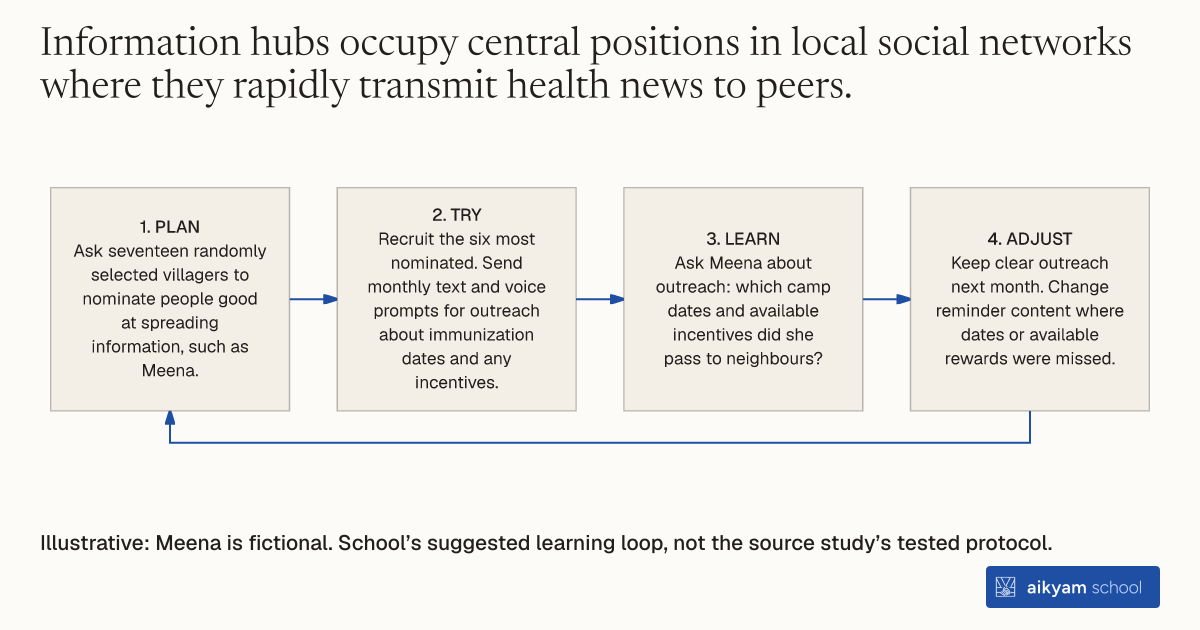
- Plan: Ask seventeen randomly selected villagers to nominate people good at spreading information, such as Meena.
- Try: Recruit the six most nominated. Send monthly text and voice prompts for outreach about immunization dates and any incentives.
- Learn: Ask Meena about outreach: which camp dates and available incentives did she pass to neighbours?
- Adjust: Keep clear outreach next month. Change reminder content where dates or available rewards were missed.
Illustrative: Meena is fictional. School’s suggested learning loop, not the source study’s tested protocol.
See source →School’s suggested, untested loop. Observe nominations, six recruits and outreach. The suggested check does not reproduce the trial’s impact estimate.
How
When to use
In rural health programs, official messaging often fails to reach or persuade all caregivers. Relying solely on health staff misses established village social networks that naturally diffuse information. Deploy this method to recruit central community figures who are skilled at sharing information as local immunization ambassadors.
Recruit community-nominated individuals who excel at relaying information to serve as local ambassadors who remind community members about child immunizations.
- Program staff survey seventeen randomly selected individuals per village to name people who are good at spreading information.
- Program coordinators aggregate nominations and recruit the six most frequently named individuals in each village as ambassadors.
- System operators transmit automated monthly reminders to each ambassador via one text message and one voice call.
- Ambassadors verbally remind friends, family, and neighbors of the value of immunization and upcoming clinic dates.
- In villages offering mobile credit rewards, ambassadors inform caregivers about the available financial incentives.
Why it works
Their outreach amplifies other program components by clarifying text messages and spreading word about incentives.
Example
In 912 villages in Haryana, India, researchers recruited information hubs who increased full child immunizations by 1.89 additional completions per village per month, representing a 26 percent increase over the comparison group.
About the study
Participants
Caregivers and children across 912 villages in seven districts of Haryana, India.
Study Design
A randomized controlled trial comparing community-nominated information hubs against other ambassador nomination strategies, incentives, and control groups.
Results
Information hub ambassadors increased full child immunizations by 1.89 completed schedules per village per month relative to 7.32 in the comparison group, achieving a 26 percent increase.