Try, learn and adjust
Check each child’s digital vaccine record
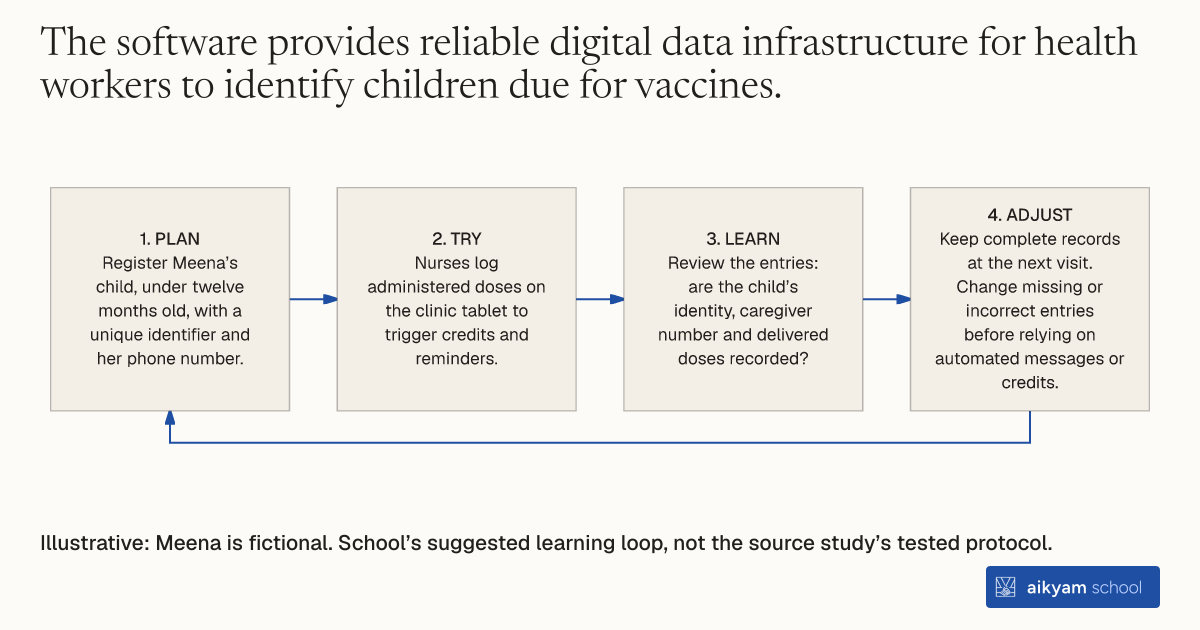
- Plan: Register Meena’s child, under twelve months old, with a unique identifier and her phone number.
- Try: Nurses log administered doses on the clinic tablet to trigger credits and reminders.
- Learn: Review the entries: are the child’s identity, caregiver number and delivered doses recorded?
- Adjust: Keep complete records at the next visit. Change missing or incorrect entries before relying on automated messages or credits.
Illustrative: Meena is fictional. School’s suggested learning loop, not the source study’s tested protocol.
See source →School’s suggested, untested loop. Observe registration and dose entries. This is a record check, not a clinical vaccination protocol.
How
When to use
Health programs in low-income settings struggle to track child vaccination visits across multiple doses. Paper registers lead to incomplete medical records and lost contact information for caregivers. Deploy this method to establish a simple digital system for health workers to record child vaccinations at local clinics.
Deploy a simple e-health software platform on tablet computers at immunization clinics to register every child and track vaccination records.
- Software developers design a cheap and simple e-health software application for tablet computers.
- Nurses carry tablet computers loaded with the software application to free monthly village immunization camps.
- Nurses register every attending child under twelve months old on the platform using a unique identification number.
- Nurses collect and log each caregiver's mobile phone number into the digital system during clinic visits.
- Nurses record every administered vaccine dose on the tablet to trigger mobile phone credits and automated text reminders.
Why it works
It also automates the delivery of financial incentives and personalized phone reminders to caregivers.
Example
In Haryana, India, researchers and local nurses used the SANA e-health platform across 140 primary health centers and 755 subcenters. Nurses registered approximately 295,000 children on the platform between 2016 and 2018.
About the study
Participants
140 primary health centers, 755 subcenters, and approximately 295,000 children under twelve months of age across seven districts in Haryana, India.
Study Design
A randomized controlled trial evaluating child immunization programs using tablet administrative data recorded by Auxiliary Nurse Midwives, verified through a sample audit of household visits.
Results
Nurses widely adopted the software platform as primary data infrastructure, successfully recording approximately 295,000 children and tracking five basic immunizations across the trial.