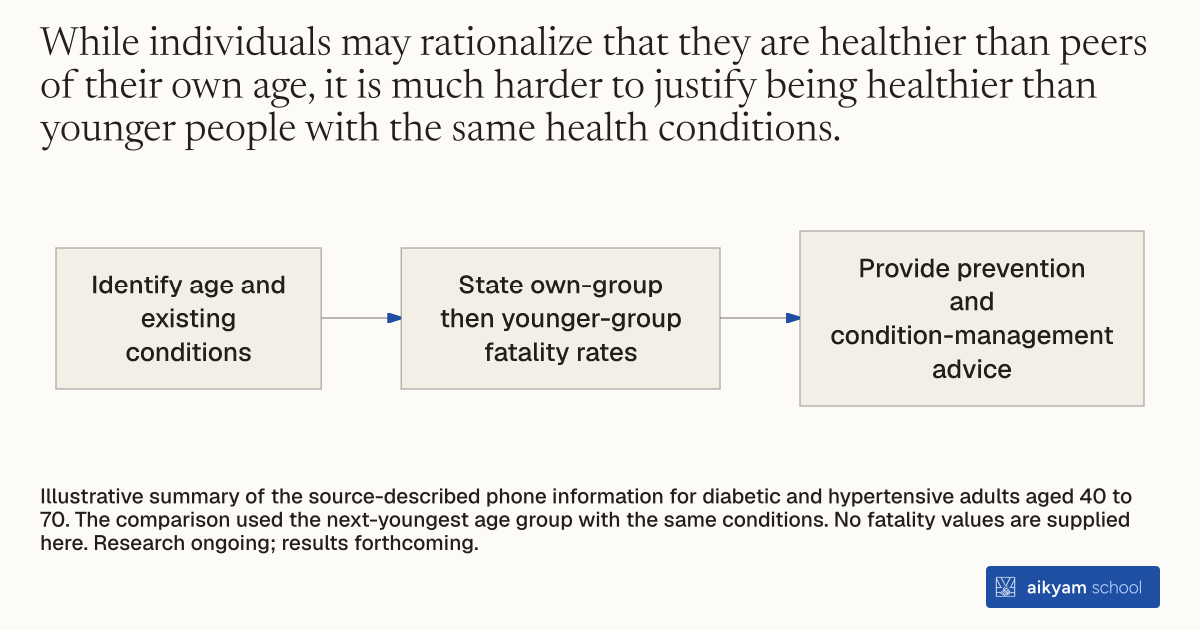
Research procedure
Describe lower-risk comparison information
- Identify age and existing conditions
- State own-group then younger-group fatality rates
- Provide prevention and condition-management advice
Illustrative summary of the source-described phone information for diabetic and hypertensive adults aged 40 to 70. The comparison used the next-youngest age group with the same conditions. No fatality values are supplied here. Research ongoing; results forthcoming.
See source →How
When to use
During an epidemic, vulnerable individuals may rationalize that they are healthier than others in their own age group. Presenting fatality rate data for a younger, lower-risk demographic makes it harder for high-risk individuals to minimize their personal risk. This method targets diabetic and hypertensive adults who underestimate their health risks.
Deliver comparative fatality rate information from a younger age group to high-risk individuals during phone communications.
- Identify the participant's age bracket and pre-existing health conditions during an initial phone call.
- Obtain Covid-19 fatality rate data for the participant's own age group and condition.
- Retrieve Covid-19 fatality rate statistics for a similar but lower-risk group, such as the next-youngest age bracket with the same health conditions.
- State the fatality rate for the participant's own age and condition group over the phone.
- Present the fatality rate of the younger, lower-risk demographic as a comparison to challenge personal risk rationalizations.
- Provide standard health advice on avoiding infection and managing underlying conditions.
Example
In Coimbatore, Tamil Nadu, India, researchers communicated Covid-19 fatality rates of the next-youngest age group over the phone to diabetic and hypertensive adults aged 40 to 70 years old.
About the study
Participants
3,680 diabetic and hypertensive individuals aged 40 to 70 years old in Coimbatore, Tamil Nadu, India.
Study Design
Randomized controlled trial providing comparative fatality rate information for a lower-risk age group via phone calls during an initial survey.
Results
Research ongoing; results forthcoming.