Research procedure
Describe over-optimism information
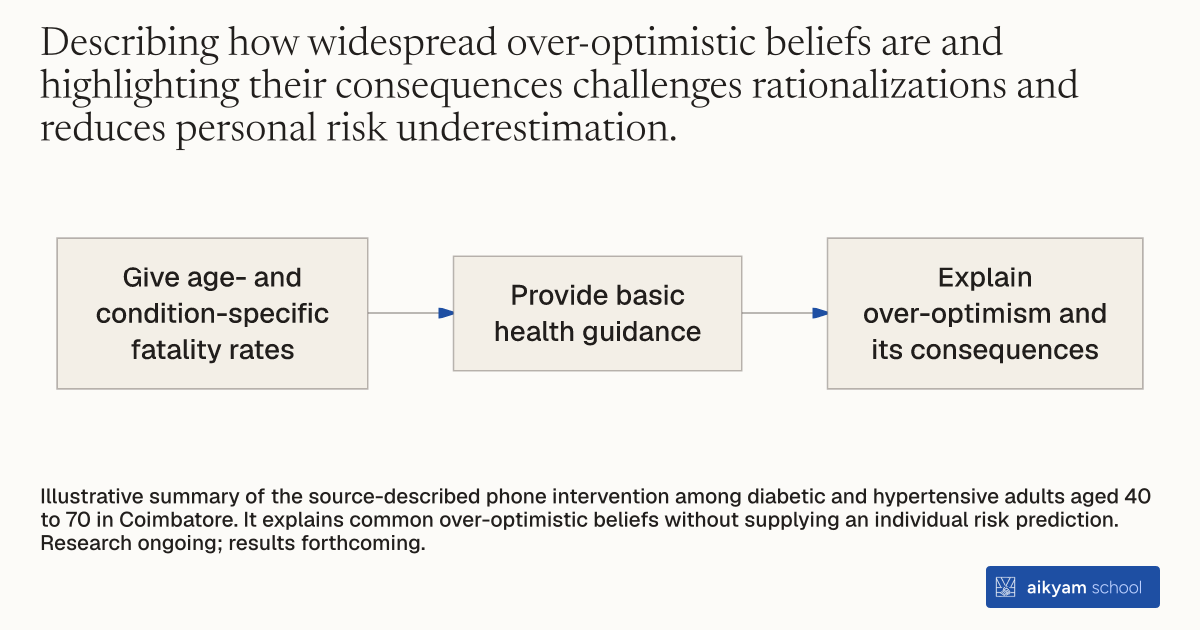
- Give age- and condition-specific fatality rates
- Provide basic health guidance
- Explain over-optimism and its consequences
Illustrative summary of the source-described phone intervention among diabetic and hypertensive adults aged 40 to 70 in Coimbatore. It explains common over-optimistic beliefs without supplying an individual risk prediction. Research ongoing; results forthcoming.
See source →How
When to use
People often underestimate personal health risks during an epidemic because of over-optimism bias. Even when aware of overall population risks, individuals believe they face lower personal danger. Providing education on over-optimistic beliefs and their consequences helps high-risk diabetic and hypertensive adults recognize their personal vulnerability.
Deliver health risk data alongside messaging that explains and challenges over-optimistic beliefs over phone calls.
- Contact diabetic and hypertensive participants aged 40 to 70 years old by phone.
- Provide specific Covid-19 fatality rates for the participant's age group and pre-existing conditions.
- Deliver standard guidance on preventing Covid-19 infection and managing underlying health conditions.
- Describe how common over-optimistic beliefs are regarding personal health risks.
- Explain the negative health consequences that result from over-optimistic thinking during a pandemic.
Example
In Coimbatore, Tamil Nadu, India, researchers delivered information on Covid-19 fatality rates, over-optimism prevalence, and its consequences to diabetic and hypertensive adults aged 40 to 70 years old over the phone.
About the study
Participants
3,680 diabetic and hypertensive individuals aged 40 to 70 years old in Coimbatore, Tamil Nadu, India.
Study Design
Randomized controlled trial providing risk data and over-optimism educational messages over phone calls during an initial survey.
Results
Research ongoing; results forthcoming.