Try, learn and adjust
Check conditional oil reaches eligible households
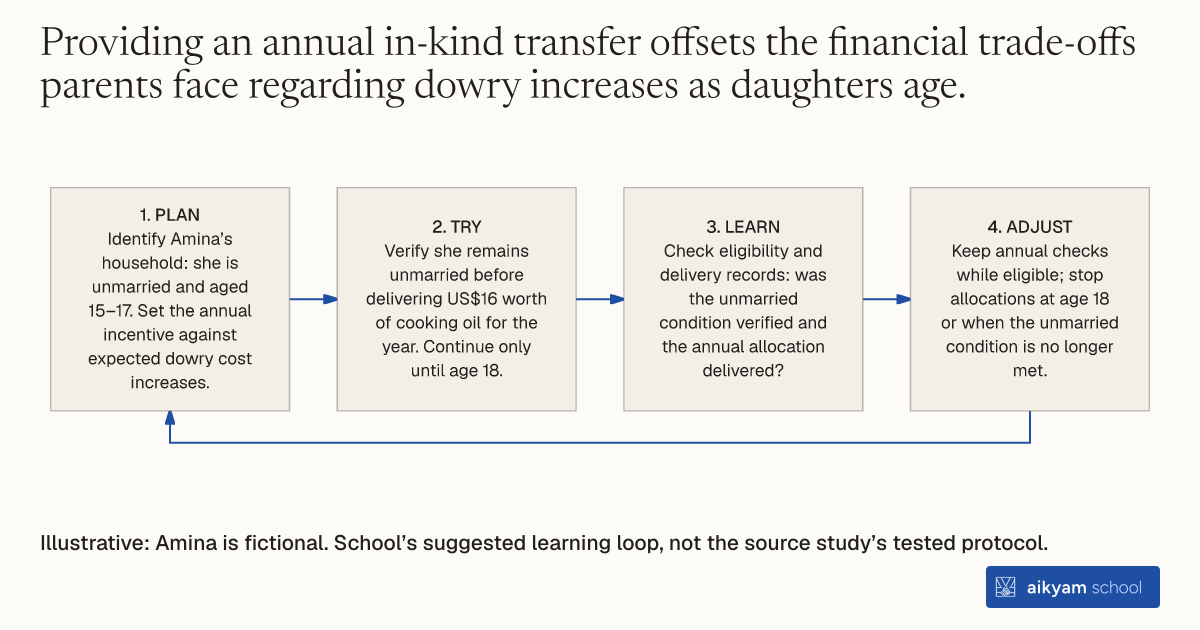
- Plan: Identify Amina’s household: she is unmarried and aged 15–17. Set the annual incentive against expected dowry cost increases.
- Try: Verify she remains unmarried before delivering US$16 worth of cooking oil for the year. Continue only until age 18.
- Learn: Check eligibility and delivery records: was the unmarried condition verified and the annual allocation delivered?
- Adjust: Keep annual checks while eligible; stop allocations at age 18 or when the unmarried condition is no longer met.
Illustrative: Amina is fictional. School’s suggested learning loop, not the source study’s tested protocol.
See source →School’s suggested, untested learning loop. Observe eligibility and annual delivery. This suggested loop does not establish marriage or pregnancy effects.
How
When to use
In settings where child marriage and dowry practices create financial incentives to marry daughters early, parents often arrange early marriages that lead to early childbearing. Offering a conditional in-kind incentive directly offsets the financial cost of delaying marriage for adolescent girls. This approach targets households with unmarried female adolescents aged 15 to 17.
Distribute an annual in-kind incentive of cooking oil to households conditional on keeping their adolescent daughters unmarried.
- Program administrators identify households with unmarried female adolescents aged 15 to 17.
- Administrators calculate the annual incentive value to match the expected increase in dowry costs resulting from postponing marriage.
- Program staff deliver US\$16 worth of cooking oil per year directly to eligible households.
- Staff verify that the adolescent daughter remains unmarried before distributing each annual allocation.
- Administrators continue annual distributions until the daughter turns 18, the legal marrying age.
Why it works
This financial support encourages parents to delay their daughters' marriage, which subsequently reduces adolescent pregnancy rates.
Example
In Bangladesh from 2007 to 2017, households received US\$16 worth of cooking oil annually conditional on daughters aged 15 to 17 remaining unmarried, which reduced marriage before age 18 by 6.3 percentage points (23 percent) and pregnancy before age 20 by 2.9 percentage points (13 percent) over four and a half years.