Research steps
Construct municipal food price indexes
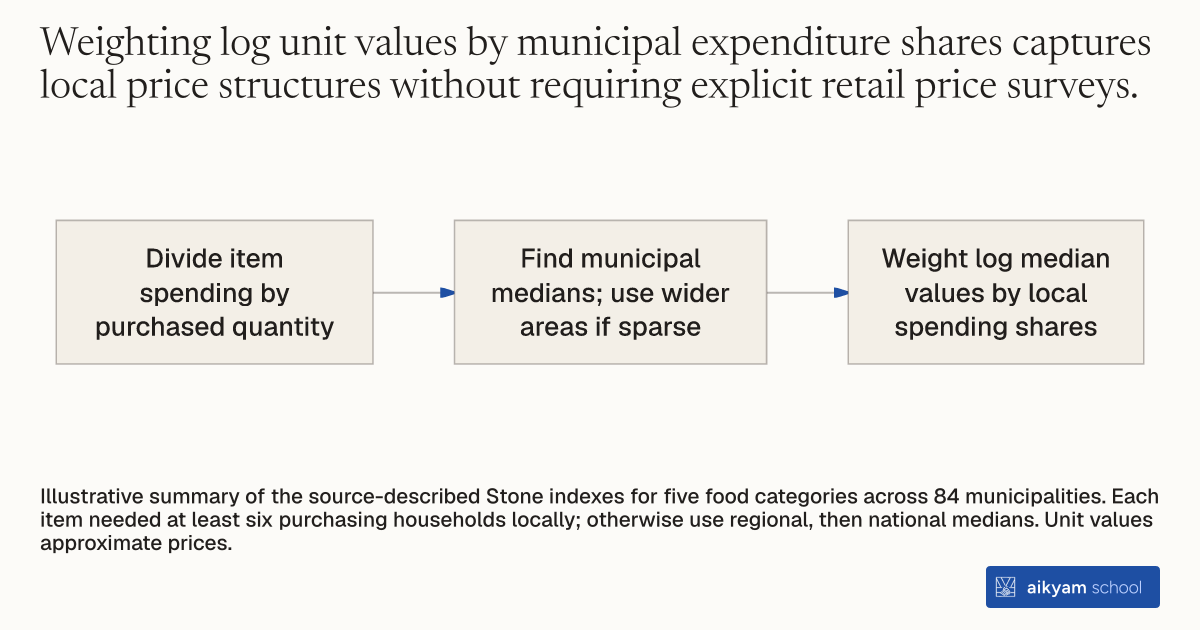
- Divide item spending by purchased quantity
- Find municipal medians; use wider areas if sparse
- Weight log median values by local spending shares
Illustrative summary of the source-described Stone indexes for five food categories across 84 municipalities. Each item needed at least six purchasing households locally; otherwise use regional, then national medians. Unit values approximate prices.
See source →How
When to use
Analyzing household expenditure patterns across different regions requires adjusting nominal spending for local price variation. When explicit retail price data are unavailable across items and municipalities, researchers approximate price levels using unit values. Constructing Stone price indexes at the municipality level provides a consistent price measure for estimating demand systems.
Construct municipal Stone price indexes by combining item-level unit values with local expenditure share weights.
- Derive unit values by dividing total household expenditure on a food item by the quantity purchased.
- Calculate median unit values at the municipality level for each food item across purchasing households.
- Require a minimum threshold of 6 purchasing households per item in a municipality to ensure reliable median unit values.
- Substitute median unit values from larger regional or national clusters when a municipality has fewer than 6 purchase records.
- Compute item expenditure weights by dividing total municipal spending on an item by total municipal spending in that food category.
- Calculate the Stone price index for each food category in each municipality by weighting log median unit values by their expenditure shares.
Why it works
Using hierarchical cluster medians ensures price index stability even when specific item transactions are rare in small municipalities.
Example
In Macedonia, researchers constructed Stone price indexes for 84 municipalities using baseline (2010) and follow-up (2012) household survey data across 5 food categories. For each item, median unit values were calculated using a 6-observation minimum per municipality, aggregating to regional or national levels when local data was sparse.
About the study
Participants
1053 households with children aged 14 to 18 sampled at baseline across 84 municipalities in Macedonia, with 830 households followed up after two years. Households averaged 4.5 members and 55 percent were Muslim.
Study Design
A randomized trial across all 84 municipalities in Macedonia, stratified by population size into 42 mother-recipient municipalities and 42 household-head-recipient municipalities. Surveys collected baseline data in 2010 and follow-up data in 2012.
Results
Controlling for geographic price variation using Stone price indexes revealed that targeting cash transfers to mothers increased the food budget share by 4 to 5 percentage points, while food prices showed no significant difference across treatment groups.