Research procedure
Ask dealers what certification is worth
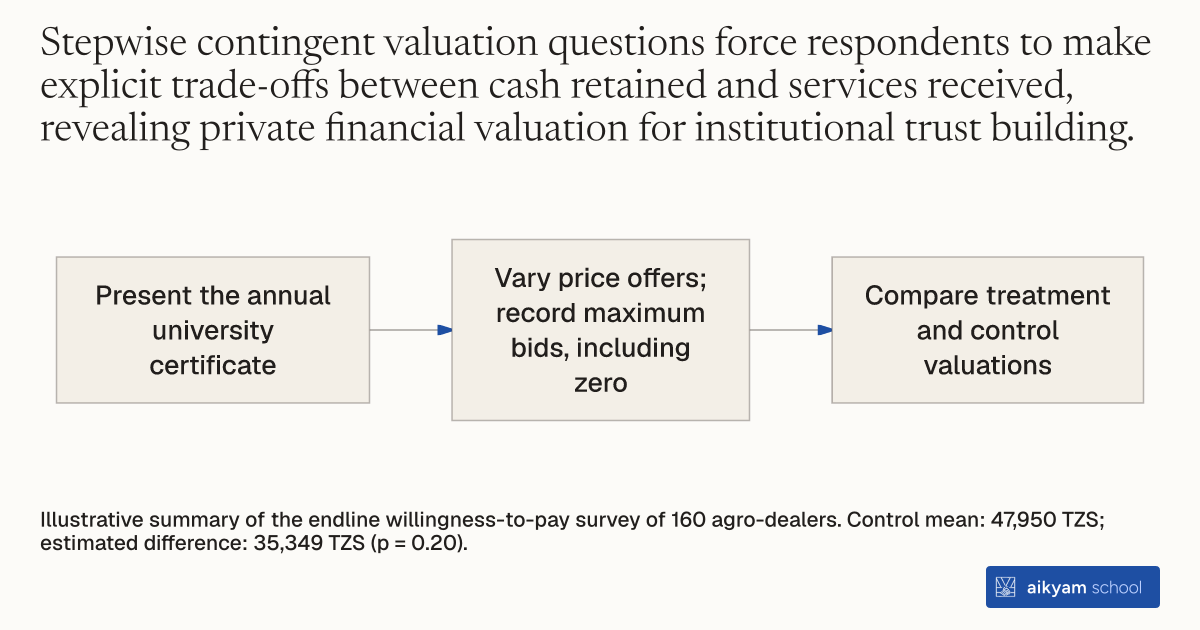
- Present the annual university certificate
- Vary price offers; record maximum bids, including zero
- Compare treatment and control valuations
Illustrative summary of the endline willingness-to-pay survey of 160 agro-dealers. Control mean: 47,950 TZS; estimated difference: 35,349 TZS (p = 0.20).
See source →How
When to use
Program designers often do not know whether private service providers or retailers value official quality certification enough to co-finance certification schemes. Unclear demand makes setting subsidised or cost-recovering fee structures difficult for market interventions. Evaluators use this method to measure commercial demand for third-party quality verification.
Elicit retailer valuation for official quality certification through structured contingent valuation survey modules asking stepwise purchase choices.
- Design a contingent valuation survey module presenting a specific, institutional quality verification certificate for retail store windows.
- Train survey enumerators to present the official certification option clearly without pressuring respondents.
- Present agro-dealers with hypothetical or real price offers for receiving an annual university quality testing certificate.
- Vary price offers systematically or use a bidding ladder to identify each dealer's maximum willingness to pay.
- Record zero-value offers explicitly alongside positive bids to capture overall market participation willingness.
- Compare mean willingness to pay across treatment and control markets to evaluate how market exposure changes demand for certification.
Example
Enumerators elicited willingness to pay for a Sokoine University of Agriculture quality certificate from 160 agro-dealers in Morogoro Region, Tanzania at endline. Control dealers offered an average of 47,950 TZS (~\$20 USD), while dealers exposed to the market certification intervention offered an additional 35,349 TZS (~\$14 USD), a 70% increase.
About the study
Participants
N = 160 agro-dealers surveyed across markets in Morogoro Region, Tanzania.
Study Design
Randomized controlled trial using endline contingent valuation survey elicitation measuring merchant willingness-to-pay for university quality certification.
Results
Exposure to market information increased agro-dealer willingness-to-pay for official quality certification by 35,349 TZS (a 70% increase over the control mean of 47,950 TZS, p = 0.20).